

Content Factory
An AI-powered system that industrializes content creation across formats - articles, videos, social posts - while maintaining brand consistency.
A Content Factory is an integrated production system that turns a strategic brief into finished, on-brand assets across every channel a brand needs to feed: blog articles, landing pages, social posts, ads, video scripts, podcast episodes, images, animations. Unlike a stack of point AI tools (one for copy, one for images, one for video), a content factory enforces a single source of truth - Brand DNA, audience persona, topic strategy - across all outputs, so the volume scales without the chaos. The shift from artisanal content (a writer per article, a designer per visual) to factory-style production is the defining operational change in marketing this decade. Done well, it raises output 10-50x without diluting brand. Done poorly, it floods channels with generic AI sludge that hurts both rankings and reputation.
Key takeaways
- 1A Content Factory unifies brief, brand voice, generation, review, and publishing in one workflow - not a stack of disconnected AI apps.
- 2The leverage comes from shared Brand DNA: every asset inherits voice, persona, banned terms, and visual identity automatically.
- 3Volume without quality control destroys rankings - factories need editorial review and structured QA, not just generation.
- 4Multi-format coverage (text, image, video, audio) is what separates a factory from a fancy article generator.
- 5The right metric is brand-consistent output per week, not raw word count or post count.
Why Content Factory matters
Content factories enable brands to scale from dozens to thousands of content pieces monthly without proportional team growth.
When to apply Content Factory
Programmatic SEO at brand-safe scale
Generate hundreds of location, product, or use-case landing pages from a structured data source while keeping each page on-brand and topically authoritative.
Always-on social presence
Maintain weekly posting cadence across LinkedIn, X, Instagram, TikTok with format-native variants - text, carousel, short video - from a single content brief.
Repurposing pillar content
Atomize a single research report into 20+ derivative assets - blog summaries, social threads, video clips, newsletter editions - without redoing the strategy.
Best practices
- Lock Brand DNA before scaling: voice, tone, vocabulary, persona, banned terms, visual style. Every output inherits this.
- Templatize per format - article, social, ad, video script - so generation is repeatable and editable, not bespoke each time.
- Insert human review at the right step: typically a fast editorial pass before publishing, not a full rewrite.
- Monitor output for sameness - LLMs converge on safe phrasings, so periodically diversify prompts and examples.
- Track which generated assets perform (rankings, engagement, conversions) and feed winners back into your prompt library.
Content Factory and OGY
OpenGraphy's Content Factory is a real, productionized content factory: articles, landing pages, social posts, video and podcast scripts, images, music, and animations - all generated against your Brand DNA so every output sounds, looks, and feels like you. You stop juggling six AI tools and one freelancer per format. One workspace, one brand voice, one publishing pipeline - 10-50x output without the chaos. Ready to industrialize your content? Activate the Factory inside OGY and ship your first on-brand asset in minutes.
Open the Content FactoryContent Factory in context
As AI-powered discovery replaces traditional search, understanding Content Factory is a core competency for modern brands. It sits in the Content Factory family of concepts and directly influences how language models like ChatGPT, Gemini, Claude, and Perplexity surface, cite, and recommend brands.
Content Factory - frequently asked questions
Quick answers to the questions people most often ask about Content Factory.
No. A real factory enforces Brand DNA across every asset, manages multi-format generation (text, image, video, audio), versions prompts as production assets, and integrates with publishing channels. ChatGPT alone is a generation primitive; a factory is the operating system around it.
It hurts SEO when it's thin, repetitive, or off-brand. Google explicitly evaluates content quality, not authorship. A Content Factory that produces source-rich, structurally sound, well-edited content earns rankings; a churn-and-burn approach gets penalized.
Volume and consistency. A senior writer produces 1-2 high-quality articles per week. A Content Factory produces 20-50 articles per week with one editorial reviewer and one strategist, while keeping voice consistent because the brand voice lives in the system, not in each writer's head.
Yes - for strategy, original POVs, founder-led content, and editorial review. The role shifts from drafting to directing: senior creators set the strategy and quality bar, the factory produces volume against it.
Three things: (1) skipping Brand DNA so outputs sound generic; (2) no editorial review so errors and on-brand failures slip through; (3) optimizing for raw volume instead of asset performance. The factories that win measure output by brand-consistent, performing assets.
Most teams see breakeven within 30-60 days when they replace point tools and outsourced freelancers with one integrated factory. The compounding gain comes later: by month 6, you're producing 10-20x your previous output with the same headcount.
Related Terms

Content Templates
Reusable frameworks that guide AI generation with brand-specific structure, tone, and formatting rules for consistent outputs.

Dynamic Content Generation
AI systems that create personalized content variations in real-time based on audience, context, and performance data.
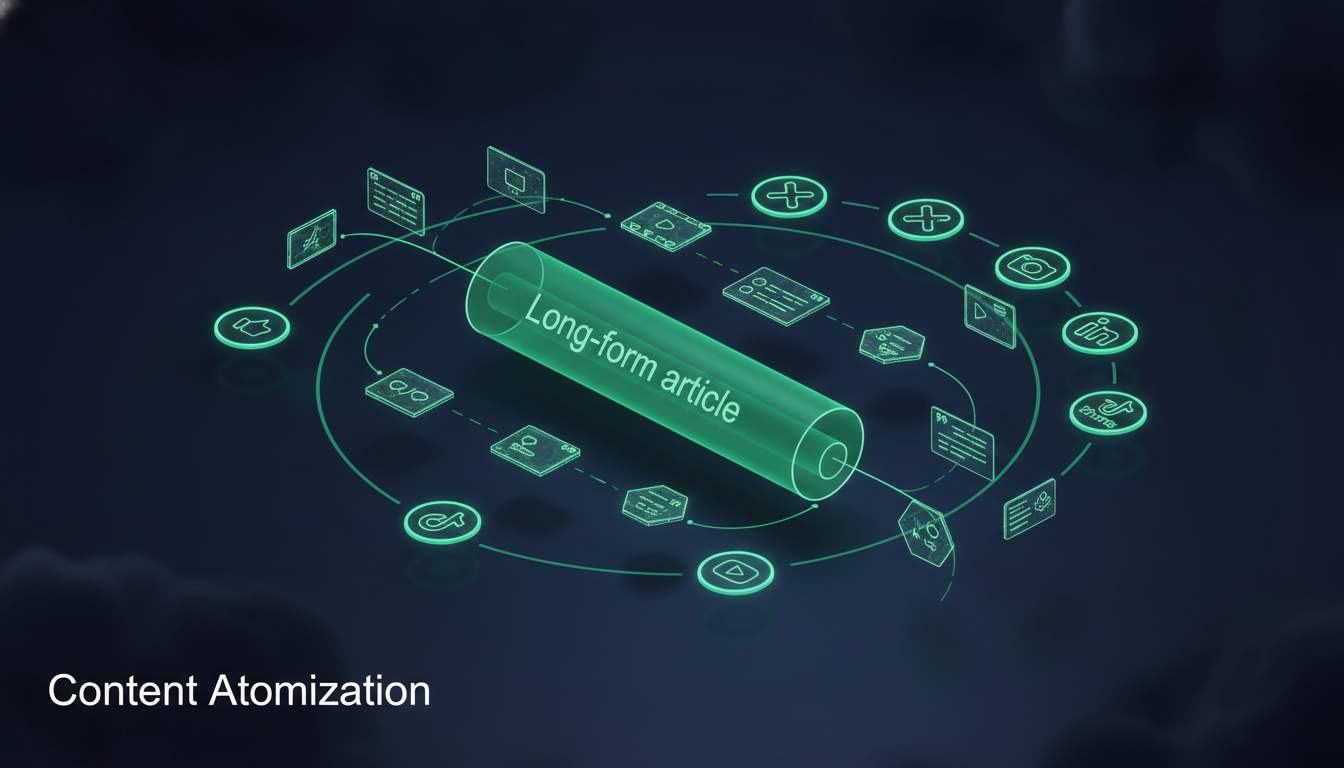
Content Atomization
Breaking down long-form content into smaller, reformatted pieces optimized for different channels and formats.