
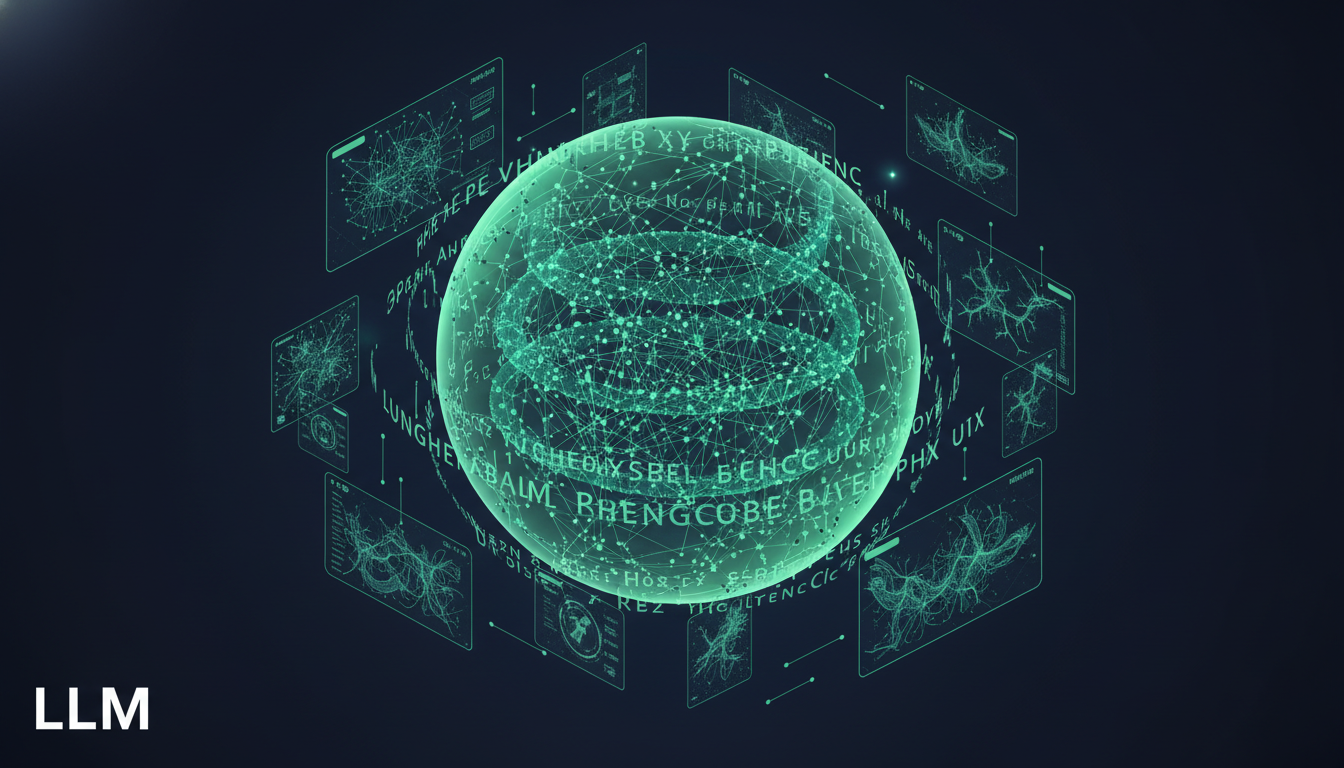
Large Language Model (LLM)
A neural network trained on massive text datasets to understand and generate human-like language, powering tools like ChatGPT, Claude, and Gemini.
A Large Language Model (LLM) is a transformer-based neural network trained on hundreds of billions of tokens of public and licensed text to predict the next token in any sequence. That seemingly narrow objective produces extraordinarily broad behaviors: summarization, translation, reasoning, code generation, and brand recommendations all emerge from the same underlying weights. Today's flagship LLMs - GPT-5, Claude 4, Gemini 2.5, Llama 4, Mistral Large - differ in size, training data, fine-tuning recipes, and grounding strategies, but they share one defining property for marketers: they are now the primary surface where consumers ask questions about products, services, and brands. Every answer an LLM produces is a stochastic mixture of its parametric memory (what it learned during training) and its retrieval layer (what it can fetch in real time), and both layers can be influenced through GEO.
Key takeaways
- 1LLMs power every major AI assistant - ChatGPT, Claude, Gemini, Perplexity, Copilot - and increasingly mediate brand discovery.
- 2An LLM's output is shaped by training data (parametric memory) and live retrieval (RAG, web search), each of which is optimizable.
- 3Different LLMs surface different brands for the same query, which is why GEO is multi-engine by design.
- 4Brands that are absent or misrepresented in LLM outputs are effectively invisible to a fast-growing share of buyers.
- 5Influencing an LLM is a long game: you optimize for the next training refresh and for live retrieval simultaneously.
Why Large Language Model (LLM) matters
LLMs are reshaping how brands appear in AI-generated answers, making traditional SEO tactics obsolete without proper GEO strategies.
When to apply Large Language Model (LLM)
Auditing brand representation
Run the same buying-intent prompt across GPT, Claude, Gemini, and Perplexity to discover how each LLM describes your brand, which competitors it surfaces, and which sources it cites.
Capturing zero-click answers
Structure your content so the LLM can lift a definitive answer - stat, definition, comparison - directly into its response, capturing demand even when the user never clicks.
Defending category leadership
If you lead a category offline, ensure that LLMs reflect that lead online; otherwise an under-funded competitor with better GEO will appear as the category default in AI answers.
Best practices
- Treat each major LLM as a separate channel: ChatGPT, Claude, Gemini, and Perplexity each have distinct retrieval mixes and training pipelines.
- Publish authoritative, source-rich content that LLMs can cite verbatim - definitions, methodology pages, original research, comparison matrices.
- Maintain entity consistency across your site, Wikipedia, Crunchbase, LinkedIn, and Knowledge Graph profiles so LLMs disambiguate you correctly.
- Track Share of Model and citation frequency monthly - LLM behavior drifts with every model refresh and retrieval index update.
- Combine technical SEO (schema, crawlability, freshness) with brand-graph signals (mentions, partnerships, reviews) since LLMs consume both.
Large Language Model (LLM) and OGY
OpenGraphy benchmarks your brand against the major LLMs - GPT, Claude, Gemini, Perplexity - in a single run. You see, per model, who shows up first, who is cited as a source, and how your brand is described, scored, and ranked. Instead of guessing which model matters or running prompts manually in four browser tabs, OGY automates the audit, tracks drift across model refreshes, and surfaces the exact entity, schema, and content fixes that move your numbers. Now that you know what an LLM is, see how the four biggest ones describe your brand right now - run a free OGY audit and get the per-model breakdown in minutes.
Run a free LLM visibility auditLarge Language Model (LLM) in context
As AI-powered discovery replaces traditional search, understanding Large Language Model (LLM) is a core competency for modern brands. It sits in the AI & GenAI family of concepts and directly influences how language models like ChatGPT, Gemini, Claude, and Perplexity surface, cite, and recommend brands.
Large Language Model (LLM) - frequently asked questions
Quick answers to the questions people most often ask about Large Language Model (LLM).
Traditional AI was task-specific: one model classified images, another translated text, another detected fraud. LLMs are general-purpose foundation models that handle dozens of tasks from a single set of weights, which is why a single model can summarize, code, plan, and recommend brands.
No. Modern LLMs combine parametric memory (training data) with live retrieval (web search, RAG, tool use). ChatGPT Search, Perplexity, and Google AI Overviews actively fetch fresh content at query time, which is why on-page SEO and freshness still matter for GEO.
Each LLM is trained on a different corpus, fine-tuned with different feedback, and retrieves from different indexes. The same prompt can yield wildly different rankings, citations, and sentiment - so you must measure and optimize per model, not in aggregate.
Yes, on two timescales. Live retrieval engines (Perplexity, AI Overviews, ChatGPT Search) reflect new content within days. Parametric memory updates only on the next training refresh - usually 3 to 9 months - so you optimize both layers in parallel.
Prioritize by audience usage. ChatGPT and Gemini dominate consumer queries; Claude and Perplexity skew toward research and developer audiences; Copilot matters for enterprise SaaS. OpenGraphy benchmarks all four in parallel so you can allocate effort intelligently.
More stable than people assume. Once an LLM forms a strong representation of your brand, that representation tends to persist across refresh cycles. The hardest work is the initial inclusion; reinforcement is cheaper.
Related Terms

Generative AI (GenAI)
AI systems that create new content - text, images, video, code - by learning patterns from training data rather than following explicit rules.

Token
The fundamental unit of text processing in LLMs, typically representing a word, part of a word, or punctuation mark.
Prompt Engineering
The art and science of crafting instructions to AI models that consistently produce desired outputs through careful wording, context, and examples.