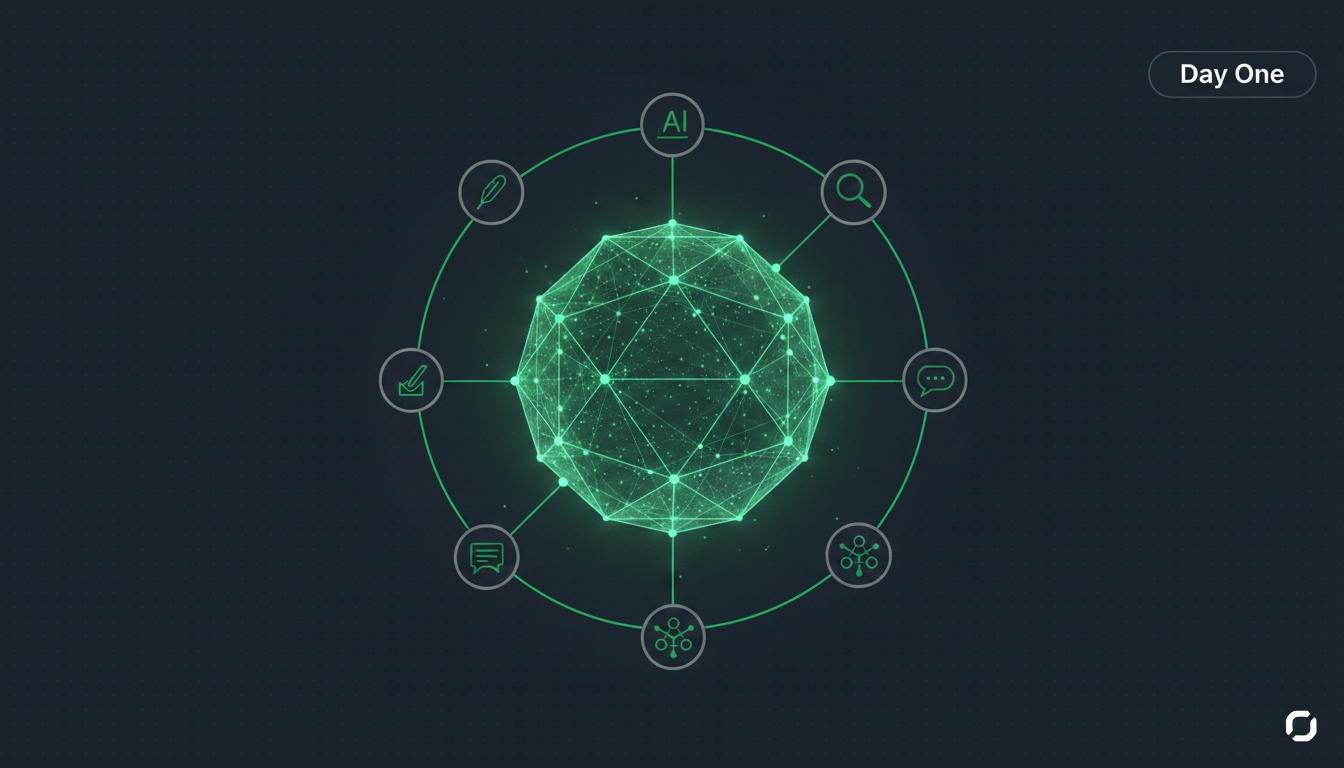
Anthropic just released Claude Opus 4.7, its most capable model to date. It is already integrated into OpenGraphy — no update to install, no new subscription to purchase. If you use OpenGraphy today, you already have access to it.
Why we integrate new models on day one

This is not a coincidence. It is the core promise of OpenGraphy.
Top AI models — from Anthropic, OpenAI, and Google — are locked behind their own expensive subscription tiers. Claude Opus 4.7 on Anthropic.ai requires a premium plan. GPT-5.5 on ChatGPT requires another. Gemini 2.0 Ultra yet another. If you subscribed to each provider individually to get their best models, you would easily spend $100–$300+ per month just in model access fees — before doing anything useful with them.
OpenGraphy works differently. One subscription gives you access to the most advanced models from every major provider, all in the same workflow. When a new frontier model ships, we wire it in as fast as possible — typically on release day or within 24 hours. Our users should never have to track model releases, sign up for new services, or wonder whether they are running on last year's intelligence.
Being on the frontier is not a feature. It is our model.
What is Claude Opus 4.7?

Claude Opus 4.7 is Anthropic's flagship reasoning model in the Claude 4 generation. It builds on Claude 3.5 Sonnet's writing quality and extends it with significantly improved analytical depth, a 200 000-token context window, and stronger agentic performance — meaning it handles complex, multi-step tasks more reliably than any previous Claude model.
Benchmark highlights (Anthropic, April 2026):
- 200 000 token context window — ingest an entire product catalogue, legal corpus, or content library in a single call.
- State-of-the-art long-form reasoning — outperforms prior models on GPQA, MATH, and multi-hop reasoning benchmarks.
- Improved instruction following — Opus 4.7 respects nuanced constraints (brand voice, tone, output format) far more consistently than its predecessors.
- Stronger agentic reliability — fewer errors when chaining tool calls, which makes it ideal for autonomous workflows.
GPT-5.5 vs Claude Opus 4.7: which one actually wins?

With both models now at the frontier, the honest answer is: it depends on the task. Here is how they compare across the dimensions that matter most for content and marketing work.
| Dimension | GPT-5.5 | Claude Opus 4.7 |
|---|---|---|
| Long-form writing quality | Excellent — structured, fact-dense | ⭐ Outstanding — more natural, flowing prose |
| Analytical reasoning | Very strong — fast multi-step logic | ⭐ Best-in-class on nuanced, multi-hop reasoning |
| Code generation | ⭐ Industry-leading for code tasks | Excellent — improved over Claude 3.5 |
| Context window | 128 000 tokens | ⭐ 200 000 tokens |
| Instruction fidelity | Strong | ⭐ Superior on brand-constrained briefs |
| Speed (latency) | ⭐ Faster on short tasks | Comparable — streaming feels snappy |
| Agentic tool use | Excellent — mature function-calling | ⭐ More reliable on long chained workflows |
| Multimodal (vision) | ⭐ Leads on image understanding | Strong — on par for text extraction from images |
| Creative voice | Versatile | ⭐ More distinctive, less generic-sounding |
| Direct subscription cost | $200 / month (ChatGPT Pro) | $100 / month (Claude Max) |
Bottom line from independent reviewers: for marketing copy, long-form articles, and agentic workflows that require strict instruction following, Claude Opus 4.7 edges ahead. For coding tasks and multimodal workloads, GPT-5.5 still leads. The real answer? You want access to both.
Where Claude Opus 4.7 is used inside OpenGraphy

Claude Opus 4.7 now powers the specialist agents in OpenGraphy that require the highest-quality output and reliable long-context reasoning:
Writing Agent
The Writing Agent uses Claude Opus 4.7 with streaming to write long-form articles, research-backed white papers, and SEO-optimized blog posts. The jump in instruction fidelity is immediately visible: brand voice constraints, heading structures, and internal linking requirements are honored precisely without post-editing.
Research Agent
The Research Agent benefits directly from the 200 000-token context window. Feeding it a full competitor content corpus, a year of GSC queries, and a brand brief in a single call is now routine. The output — competitive gap analysis, trend reports, content strategies — is noticeably richer.
Social Agent
The Social Agent leverages Claude Opus 4.7's improved creative voice to produce platform-native copy that does not sound machine-generated. LinkedIn thought leadership posts, Twitter threads, and Instagram captions each get a distinct voice.
SEO & GEO Agent
The GEO Agent uses Claude Opus 4.7 to produce nuanced entity-optimization recommendations and schema markup explanations that match the reasoning depth expected by search engineers.
One subscription. Every frontier model. From day one.

This is the contract we make with every OpenGraphy user. You should not have to:
- Track AI news to know when a new model ships.
- Sign up for a new service and pay an extra subscription.
- Manually switch your workflow to a new provider.
- Wait weeks for a platform update.
Anthropic charges $100/month for access to Claude Opus 4.7 alone. OpenAI charges $200/month for GPT-5.5. Google charges for Gemini Ultra access. If you needed all three, you would spend over $400/month — just in model fees, before generating a single piece of content.
OpenGraphy gives you all of them in a single subscription, wired into workflows purpose-built for content strategy, AI visibility, and marketing automation. We monitor every major lab's release schedule and ship integrations as fast as humanly possible — usually on day one.
Claude Opus 4.7 is proof of that commitment.
Related reading
Ready to put this into action?
Explore our Agents features and start optimizing today