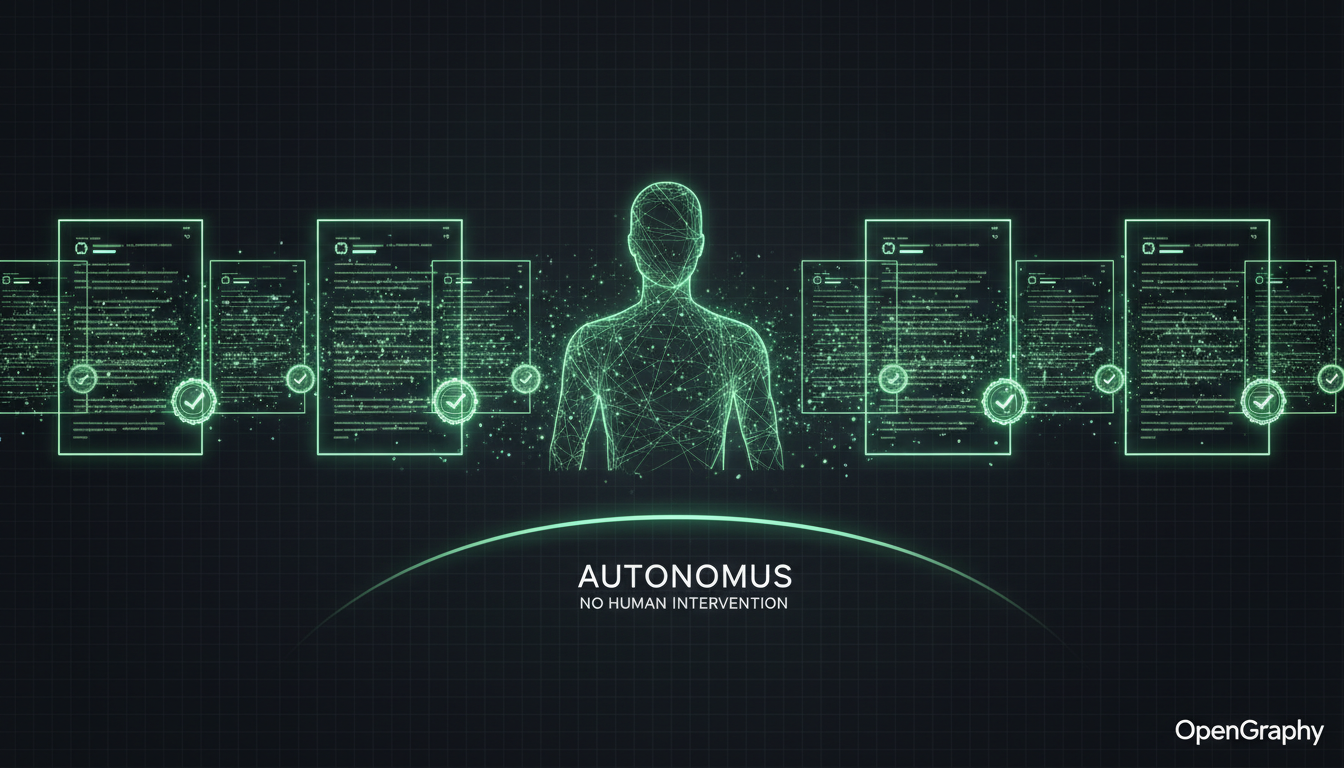
Autonomous content creation is not "AI writes a blog post." It's a stack of specialized agents — research, writing, visuals, scheduling, publishing — that runs an entire content operation end-to-end. This guide breaks down the topology, the quality gates and the staged rollout that turn a 3-person marketing team into the output of a 30-person agency.
The phrase "autonomous content creation" gets used loosely. To one team it means generating an article with ChatGPT and pasting it into WordPress. To another it means a fully orchestrated pipeline that researches, writes, illustrates, schedules, publishes, measures and iterates without human intervention beyond editorial direction. The gap between those two definitions is exactly what separates teams that get marginal AI productivity from teams that 10x their content output.
This guide walks through the production-grade definition: the agent topology, the manual-to-autopilot migration path, the quality gates that prevent off-brand or unsafe output, and the ROI math that justifies the investment. By the end, you should be able to design and roll out an autonomous content operation tailored to your team size and risk profile.
From Manual to Autonomous

The shift from manual to autonomous content creation isn't a binary flip; it's a three-stage migration. Most teams that fail at "autonomous AI" failed because they tried to skip stages. The right path is staged: assisted, then semi-autonomous, then full autopilot.
Stage 1 — Assisted (1 agent, 1 task)
You start with a single agent doing a single task: the Article Generator drafts long-form posts that humans edit and publish. No multi-agent orchestration, no autonomy. The goal here is calibration — you learn what the agent does well and where it needs guardrails. Most teams spend 2–3 weeks here.
Stage 2 — Semi-autonomous (3+ agents, 1 workflow)
The Research Agent proposes topics, the Article Generator drafts, the Image Generator creates the hero image. A human reviews and publishes. This is where most B2B teams stay for the first quarter — the productivity gain is already 4–5x manual, the risk envelope is still tight.
Stage 3 — Full autopilot (all agents, autonomous publishing)
The full stack — research, writing, visuals, scheduling, publishing, measurement — runs end-to-end. Humans review weekly summaries instead of individual posts. This is where autonomous content creation actually delivers on its promise: a small team running an output cadence that would otherwise require a 20-person content agency.
The Autopilot Content Pipeline

The autopilot pipeline has five stations, each owned by a specialized agent or generator. Outputs flow forward; nothing waits for a human unless you explicitly insert a review gate.
Station 1 — Research
The Research Agent ingests your latest stress test data, your competitive intelligence, and your AI Visibility Score gaps. It outputs a 4-week themed editorial plan: pillar topics, supporting subtopics, key questions to answer, target keywords. This is the editorial backbone — the rest of the pipeline reads from it.
Station 2 — Writing
For each scheduled topic, the Article Generator produces the long-form pillar (1,500+ words, H2-optimized for cocon sémantique, schema-ready). The Social Post Generator produces platform-native variants for LinkedIn, X, Instagram and email. All generators read the same Brand DNA, so voice stays consistent.
Station 3 — Visuals
The Image Generator creates hero images and in-article visuals. The Video Generator produces video companions for high-stakes pillar pieces. See AI Video Production: A Complete Guide for the visual pipeline.
Station 4 — Scheduling
The Scheduler Agent assigns optimal publish slots across channels using audience activity data and channel-specific algorithm rules. See AI-Powered Content Scheduling Strategies for the timing logic.
Station 5 — Publishing and measurement
The Publishing Agent distributes platform-native variants. Performance flows back into the Research Agent next cycle. See Multi-Channel Publishing Automation for the distribution layer.
Maintaining Quality

The fear of autonomous content is always the same: off-brand output, factual errors, tone drift, regulatory misses. These are real risks — but they're configuration problems, not technology problems. The autopilot pipeline ships with three quality controls that, set up once, prevent 95% of failure modes.
Brand DNA as the universal style guide
Every generator reads your Brand DNA before producing. Tone, vocabulary, banned words, color palette, voice rhythm. This is the single highest-leverage configuration step — teams that skip it ship generic content; teams that invest 1–2 hours here ship on-brand for years.
Templates as the visual style lock
The Templates Library locks in your visual identity for headers, social cards, video keyframes and email layouts. Templates prevent the slow drift that happens when 1,000 generated assets each pick slightly different styles.
Approval gates for high-stakes content
Configure per-asset-type review rules. UGC reposts, repurposed quotes and scheduled reminders publish autonomously. Customer stories, regulatory commentary, product launches and executive POV pieces flag for human review. Most teams reach 80% autonomous after one quarter.
Drift audits
Quarterly: sample 20 random shipped posts and grade tone fidelity. If drift is detected, update Brand DNA. This is the single intervention that protects brand voice over years of autonomous publishing.
The ROI Math: What Autonomous Content Actually Costs and Saves
The case for autonomous content is cleanest when you stop comparing tools and start comparing operating models.
Manual content economics
A typical B2B content operation produces 2–4 pillar articles per month + 12–20 social posts + 1–2 videos. Cost: roughly $15k–$40k per month in marketer + freelancer + agency fees. Calendar time per pillar: 2–3 weeks. Output per quarter: 6–12 pillars, 36–60 social posts.
Agent-driven economics
Same B2B team, autopilot stack: 8–12 pillars per month, 80–120 social posts, 8–12 video assets. Cost: roughly $2k–$5k per month in generation credits + 1 marketer's time. Calendar time per pillar: 30 minutes of strategic input. Output per quarter: 24–36 pillars, 240–360 social posts.
The compounding gain
Volume changes outcomes. With 3–6x output, you can A/B test hooks, run multivariate format experiments, build the kind of topical authority that compounds AI visibility quarter over quarter. That's the real ROI — not the cost savings, but the strategic possibilities the cost savings unlock.
Common Mistakes to Avoid
Skipping Brand DNA setup
Number-one cause of "AI looks generic" complaints. Configure DNA before turning on any autonomous publishing.
Going to full autopilot on day one
The crawl-walk-run path exists for a reason — early misfires teach you what to gate. Skip the staging and you'll publish off-brand content publicly before catching it.
No measurement layer
Without engagement and pipeline data flowing back into the Research Agent, the system can't tune. It just keeps running. Wire up GA, your CRM and your stress tests before going autonomous.
Treating it as "set and forget"
Autopilot still needs editorial direction. The marketer's job shifts from "writing posts" to "directing strategy and reviewing performance" — but the role doesn't disappear.
FAQ: Autonomous Content Creation
What is autonomous content creation?
An end-to-end content operating model where specialized agents — research, writing, visuals, scheduling, publishing, measurement — handle every stage of content production with minimal human intervention beyond editorial direction. Different from "using ChatGPT to write blog posts" because the workflow itself is automated, not just the writing step.
How is it different from generative AI tools like ChatGPT or Claude alone?
ChatGPT writes when prompted. The OpenGraphy agent stack runs a workflow: research feeds writing feeds visuals feeds scheduling feeds publishing feeds measurement, with feedback loops between each stage. Different category of system.
Won't autonomous content lose brand voice?
Only if Brand DNA isn't configured. With DNA setup, Templates Library locked, and quarterly drift audits, autonomous content is indistinguishable from manually written content — often better, because it's produced from a consistent style guide.
What's the safest way to roll out?
The crawl-walk-run path: 2–3 weeks in assisted mode (1 agent, human reviews everything), 4–8 weeks in semi-autonomous (3+ agents, human reviews finals), then graduate to full autopilot for routine content while keeping review on high-stakes pieces. See AI Agent Best Practices for Marketing Teams.
How much does autonomous content cost vs. agency or freelance?
For a typical B2B output cadence (8–12 pillars/month, 80–120 social posts), the agent stack runs 70–85% cheaper than agency equivalents while producing 3–6x output. The compounding gain on AI visibility is the harder-to-quantify benefit.
What about regulated industries?
Tighter approval gates: every customer-facing post passes through human review before publication. The agents still save time by drafting from briefs — humans approve compliant copy instead of writing from scratch.
Going Further
- Building Effective Agent Workflows — the orchestration patterns behind multi-agent operations.
- AI Agent Best Practices for Marketing Teams — the staged-autonomy migration path.
- Multi-Channel Publishing Automation — the distribution layer.
- AI-Powered Content Scheduling Strategies — the timing layer.
- Using Templates to 10x Content Productivity — the template foundation that prevents drift.
Ready to put this into action?
Explore our Agents features and start optimizing today