A great video script can save a thin production. A weak script kills a polished one. The Hook → Problem → Solution → Proof → CTA framework is what high-converting B2B video scripts follow — and exactly what the OpenGraphy Video Script Generator outputs by default.
Most marketing teams think of video as a production problem: cameras, edits, motion graphics. The teams that ship video that converts know the production layer is the easiest part. The hard part is the script. Three seconds to stop the scroll, twelve to demonstrate relevance, thirty to land the product, ten to close. Get the script wrong and the best production in the world won't recover the conversion. Get it right and even modest production over-performs.
This guide breaks down the production-grade approach to writing video scripts that convert: the five-stage framework, the timing rules per stage, the format-specific adaptations for short-form vs. long-form, and the script-to-production workflow that turns scripts into shipped video assets. By the end you should be able to write — or generate, with the Video Script Generator — scripts that move buyers, not just impressions.
The Script Framework

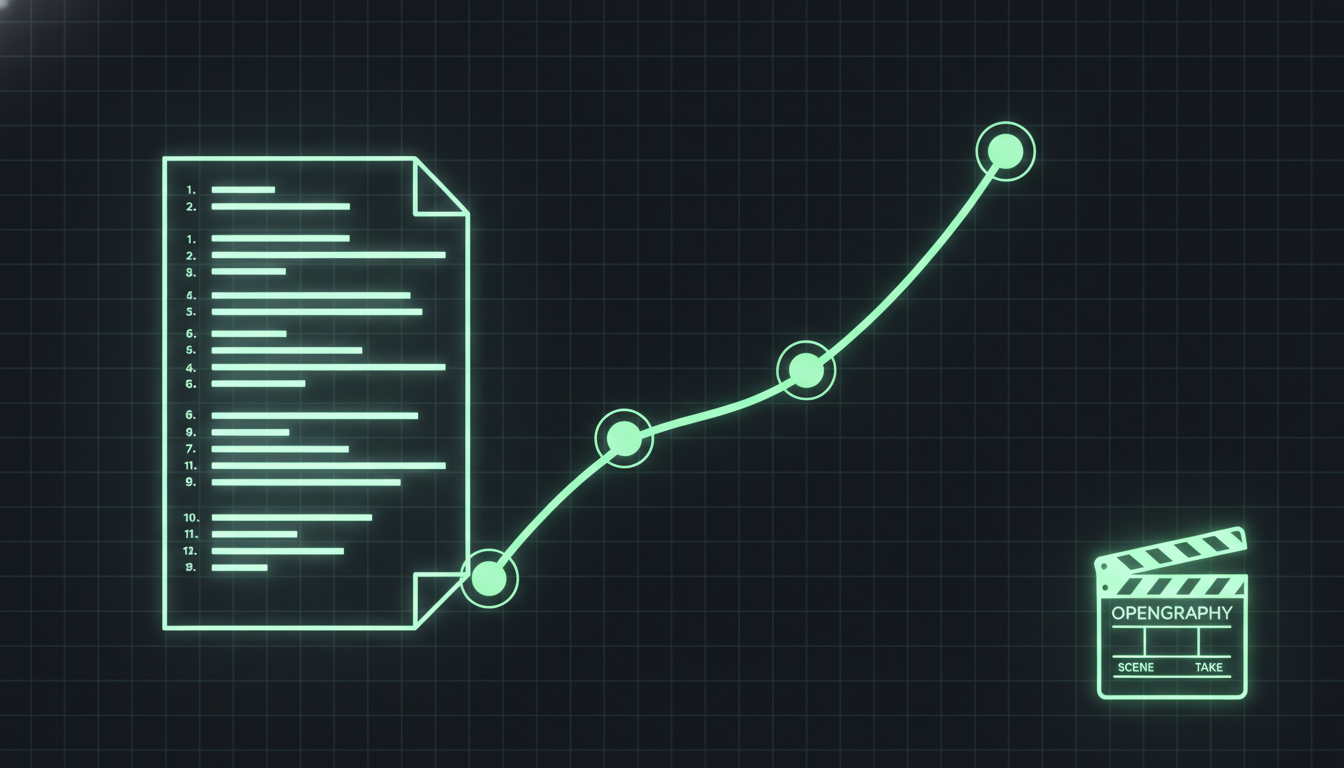
The Hook → Problem → Solution → Proof → CTA framework has been validated across thousands of B2B videos in 2024–2025. Each stage owns a specific time window and a specific job. Skip a stage and the conversion drops measurably; respect them and the script ships consistently.
Why this framework over alternatives
Other frameworks exist (PAS, AIDA, StoryBrand). H-P-S-P-C is the version optimized for short-form video specifically — where attention windows are measured in seconds and proof can't fit a 5-paragraph case study. The framework's compression is the feature, not a limitation.
How the framework maps to durations
The exact durations shift with format (a 60-second explainer compresses; a 3-minute deep-dive expands), but the proportions stay consistent. Hook ≈ 5%, Problem ≈ 25%, Solution ≈ 50%, Proof ≈ 15%, CTA ≈ 5%. Every script you write should respect these ratios within the format.
Hook (0-3 seconds)

You have three seconds to stop the scroll. The best B2B hooks pattern-interrupt: a bold claim, a counterintuitive observation, or a relatable pain point in the buyer's exact language.
Hook patterns that work in B2B
Bold claim — "Most B2B teams are wasting 60% of their content budget on the wrong channels." Counterintuitive observation — "The best time to post on LinkedIn isn't 9am — and that's costing you reach." Pain-point question — "Spending 8 hours a week on social media scheduling? You're doing it wrong."
Hook patterns that don't work
Brand intros ("Hi, we're [brand] and we help..."). Generic openings ("In today's world of..."). Setup-heavy hooks that delay the payoff. None survive the 3-second window.
Visual hook over verbal hook
For mute-default platforms (Instagram, TikTok, X), the visual hook matters as much as the script. The first frame needs a visual pattern interrupt: motion, contrast, an unexpected composition. The script supports the visual, not the other way around.
Problem (3-15 seconds)

The problem stage agitates the pain point your hook surfaced. Specific scenarios outperform abstract statements; relatable language outperforms industry jargon.
Specific over abstract
"Marketing teams struggle to scale content" is abstract and vague. "You publish three articles a week, but two of them never get past 200 views — and you can't figure out why" is specific, scenario-rich and relatable. Specifics earn permission to keep watching.
Three-scenario rule
The strongest problem stages reference three different specific scenarios in 12 seconds. Variety signals "I understand the breadth of your situation"; one scenario can feel narrow. Three scenarios = three chances for the viewer to feel seen.
Avoid the trap of dwelling
Problem agitation works because it's brief. Spend more than 15 seconds on the problem and viewers disengage — they came for solutions, not for sympathy. Move forward.
Solution (15-45 seconds)

The solution stage demonstrates your product in action. Show, don't tell. Visuals make a massive difference here — script choices that maximize visual content over verbal explanation convert better.
Demonstration over description
"Our scheduler automatically picks the best time" is description. A 5-second screen capture showing the scheduler picking a slot — with the user reaction visible — is demonstration. Demonstration converts; description doesn't.
One key feature, deeply
The temptation is to demo everything. Resist it. One feature shown deeply (with the user benefit visible) outperforms five features shown shallowly. If you have multiple things to demo, ship multiple videos.
The "moment of relief"
The strongest solution segments include a visible "moment of relief" — the buyer's pain dissolving as the solution kicks in. A face going from frustrated to calm, a dashboard switching from red to green, a calendar emptying. Visual relief converts.
From Script to Production

A finished script is the entry point to production, not the end state. The five-stage workflow that takes a script through to a published video.
Stage 1 — Script (Video Script Generator)
The Video Script Generator takes a brief and produces an H-P-S-P-C script with timing markers, voiceover cues and visual notes. Typical output: 60–120 seconds of script in 2–3 minutes.
Stage 2 — Visuals (Image Generator)
The Image Generator creates keyframes for each script stage — pattern-interrupt hook frame, problem-state visuals, solution demo frames, proof element, CTA endcard.
Stage 3 — Production (Video Generator)
The Video Generator assembles keyframes into motion footage with platform-correct aspect ratios. See AI Video Production: A Complete Guide.
Stage 4 — Promotion (Social Post Generator)
The Social Post Generator creates the platform-native posts that promote the video — LinkedIn caption, X tweet, Instagram caption, email blurb.
Stage 5 — Distribution (Video Agent + Publishing Agent)
The Video Agent orchestrates final delivery; the Publishing Agent distributes platform-native versions. See Multi-Channel Publishing Automation.
FAQ: Video Scripts That Convert
What's the H-P-S-P-C framework?
Hook → Problem → Solution → Proof → CTA. The five-stage framework optimized for short-form B2B video conversion. Each stage owns a specific time window and a specific job.
How long should a B2B video be?
For social: 15–60 seconds for hook films, 60–180 seconds for explainers. For YouTube and long-form: 3–10 minutes for educational content, 10–30 minutes for deep dives. The framework scales across durations.
How do I write a strong hook?
Three patterns: bold claim, counterintuitive observation, pain-point question. Avoid brand intros, generic openings and setup-heavy hooks. Three seconds to stop the scroll — every word counts.
Should I write the script or generate it?
Both. The Video Script Generator produces strong drafts in minutes. Most teams have the editorial director add the angle/specifics in 10 minutes of editing. The combination beats either alone.
How do I know if my script will convert?
Check three things: does the hook stop the scroll in 3 seconds? Does the problem stage feel specific (three scenarios, not abstract)? Does the solution demonstrate (not just describe)? Scripts that pass all three convert; scripts that miss one rarely do.
What's the most common script mistake?
Spending too long on brand intro and problem agitation. The scroll-past rate is highest in the first 8 seconds; a script that doesn't reach the solution by second 15 leaks viewers continuously.
Going Further
- AI Video Production: A Complete Guide — the production layer.
- End-to-End Video Production Automation — the agent workflow.
- UGC Content Strategy for Modern Brands — UGC scripts apply the same framework.
- AI Image Generation Tips for Professional Results — keyframe production.
- Using Templates to 10x Content Productivity — script templates.
Ready to put this into action?
Explore our Content features and start optimizing today