
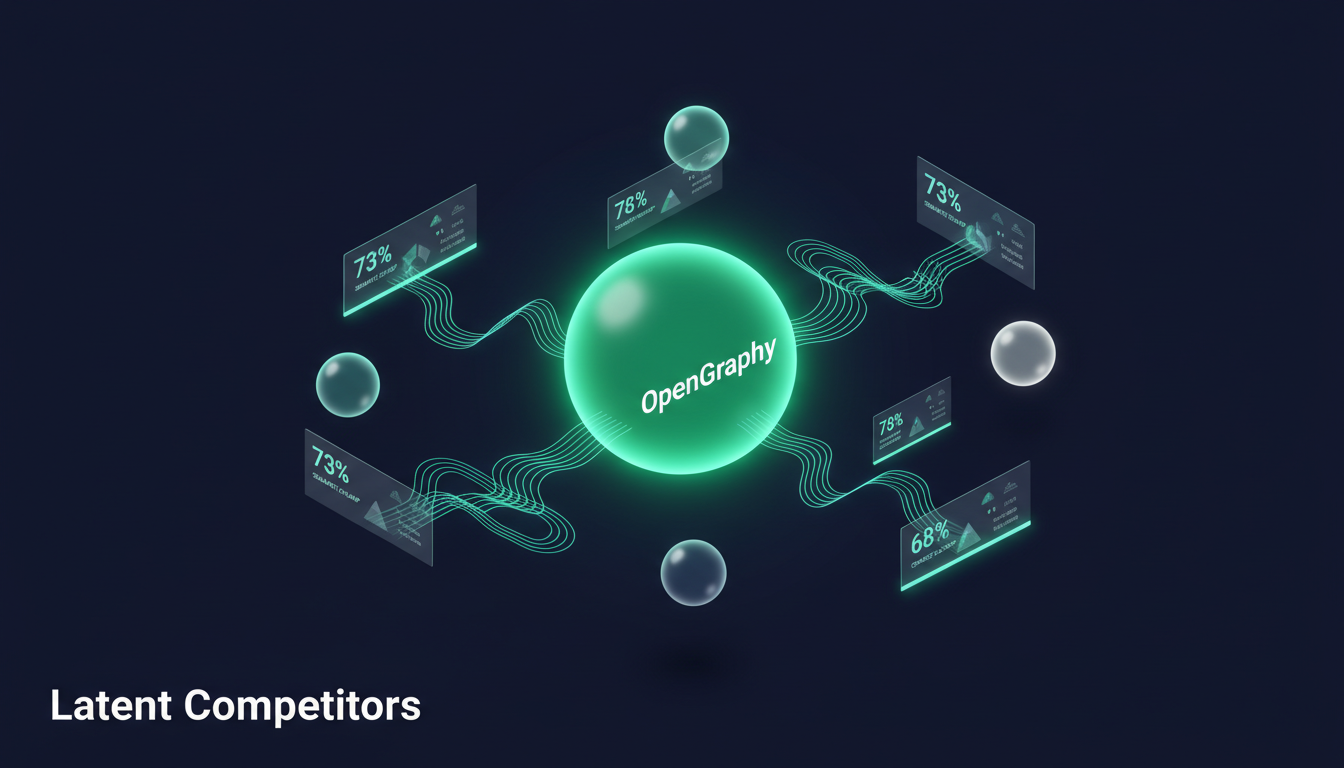
Latent Competitors
Brands that AI models consider related or alternative to yours based on semantic similarity, regardless of traditional market definitions.
Latent competitors are the brands that an AI model considers viable alternatives to yours, even if they don't appear in your traditional competitive set. They emerge from the geometry of latent space: any brand that sits close to yours along the dimensions a user's prompt activates becomes a candidate recommendation. Identifying latent competitors is one of the most actionable GEO exercises, because it surfaces the brands actually winning answers in your category - often before you've heard of them.
Key takeaways
- 1Latent competitors are model-perceived alternatives, not market-defined rivals.
- 2They are surfaced by analyzing co-mention and embedding proximity in AI answers.
- 3Indirect or adjacent-category brands often appear - e.g., a SaaS tool listed beside an open-source project.
- 4They change as the model's training data and the user's prompt phrasing change.
- 5Tracking them is the AI-era replacement for static SWOT competitor lists.
Why Latent Competitors matters
These hidden competitors steal mindshare in AI recommendations even if they're not direct business rivals, requiring new competitive analysis.
When to apply Latent Competitors
Discovery audits
Run 100+ category prompts and tally every co-mentioned brand to build a model-perceived competitor map.
Win-loss analysis
When a competitor wins an answer you should have won, compare embeddings and citations to diagnose the gap.
Category expansion
Identify latent competitors in adjacent verticals to spot opportunities to expand your positioning.
Best practices
- Refresh latent competitor lists at least every quarter - they shift faster than market reality.
- Pay attention to brands that appear in 30%+ of your category's AI answers, even if they're unknown to your team.
- Track which prompts surface which competitors - the prompt phrasing reveals what the model thinks they're best at.
- Don't dismiss latent competitors as 'wrong' - if the model lists them, users will see them.
- Use OpenGraphy's competitor module to automate cross-model latent competitor detection.
Latent Competitors and OGY
OpenGraphy's Latent Competitors detector runs hundreds of category prompts through every major AI model, tallies every co-mentioned brand, and ranks them by how often they steal answers from you. You see the model-perceived rivals you didn't know existed, with citation counts, sentiment, and the prompts where they win. Instead of a static SWOT slide, you get a living map of who AI thinks you compete with - plus the entity, schema, and content moves to displace them. Ready to see who's actually winning your category in AI? Activate the detector on your brand and you'll have your first competitor map in minutes.
Find your latent competitorsLatent Competitors in context
As AI-powered discovery replaces traditional search, understanding Latent Competitors is a core competency for modern brands. It sits in the GEO & AI Visibility family of concepts and directly influences how language models like ChatGPT, Gemini, Claude, and Perplexity surface, cite, and recommend brands.
Latent Competitors - frequently asked questions
Quick answers to the questions people most often ask about Latent Competitors.
Run a representative set of category and intent queries through every major AI model and capture every co-mentioned brand. Rank by frequency, then compare to your traditional competitor list to find the surprises.
Not always. Some are partners, complementary tools, or open-source projects. The threat level depends on whether they are positioned as substitutes for you in answers users actually run.
Because models reason on semantic proximity, not market structure. A brand that shares vocabulary, audience, or use case can be retrieved as an alternative even if it operates in a different segment.
Publish content that strengthens your association with the prompts they currently win, earn authoritative citations on those topics, and ensure your structured data clearly disambiguates your category position.
Yes - materially. A brand may be your top latent competitor in Perplexity yet absent in Gemini. Track per-model and prioritize the engines your audience uses.
Sparingly. Comparison content can reinforce association in latent space, sometimes helping the competitor more than you. When you do compare, do so with depth and evidence.
Related Terms

Generative Engine Optimization (GEO)
The practice of optimizing content and digital presence to rank highly in AI-generated answers from ChatGPT, Perplexity, Gemini, and similar platforms.
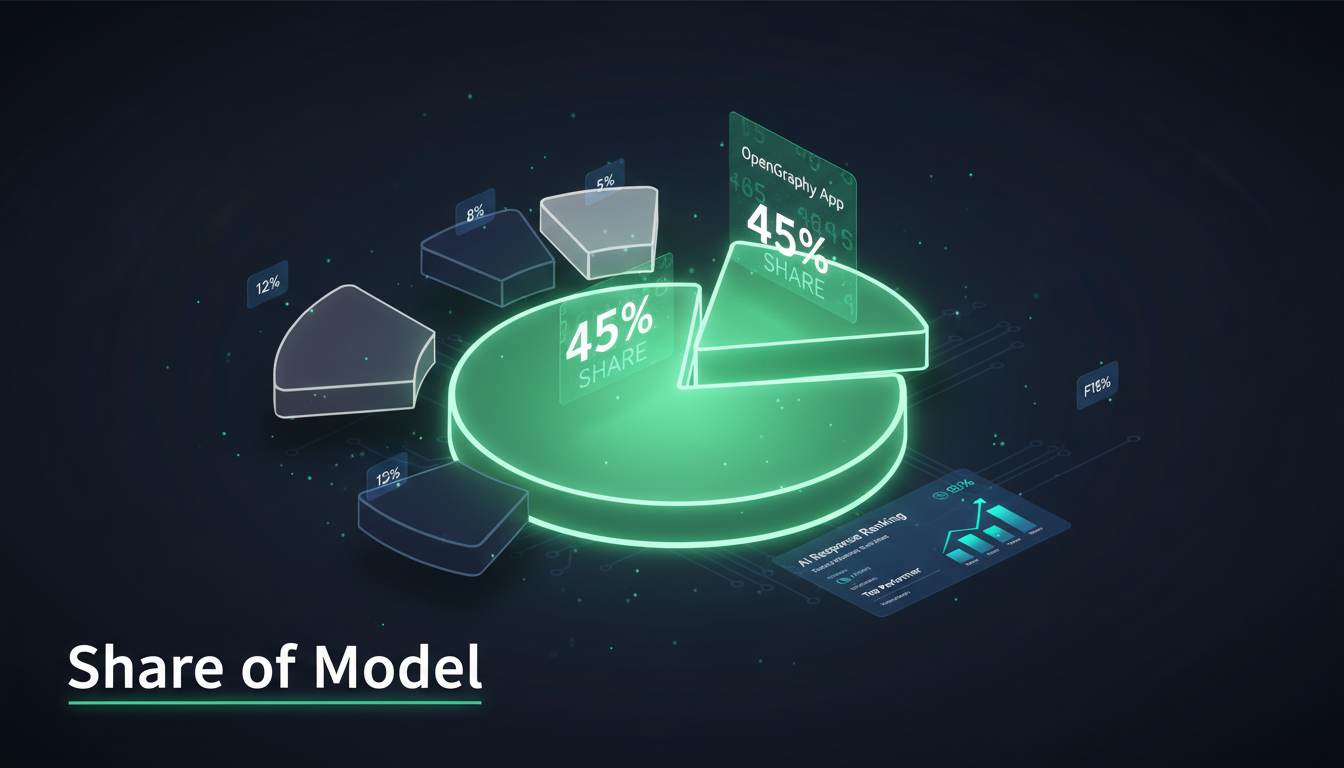
Share of Model (SoM)
A metric measuring how often a brand is cited or recommended in AI-generated answers across multiple AI platforms, replacing traditional Share of Voice.

AI Visibility Score
A composite metric quantifying a brand's presence, authority, and favorability across AI model responses and training data.