Latent Space
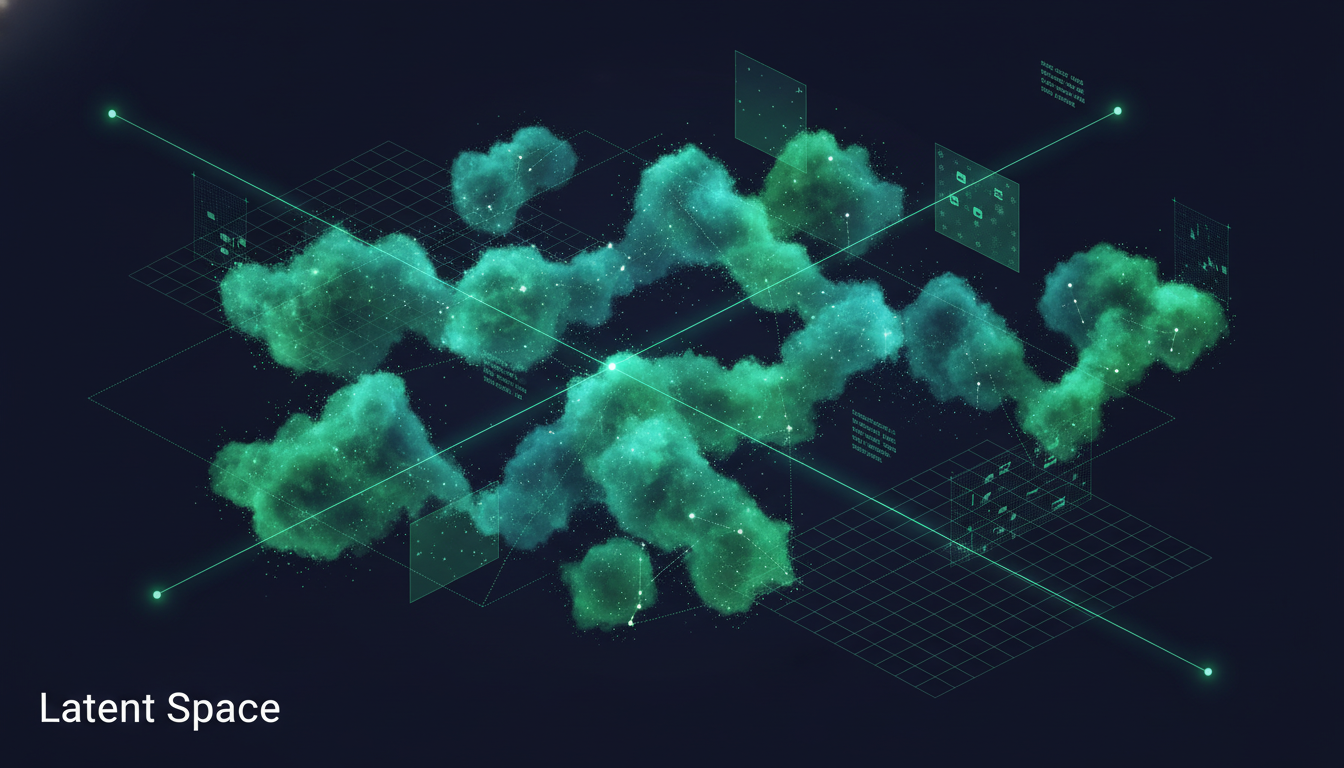
The multi-dimensional representation space where AI models encode concepts, determining semantic relationships and proximity between ideas.
Latent space is the high-dimensional vector space in which neural networks encode meaning. Words, sentences, brands, and entire concepts are projected into this space as numerical vectors, and similarity is measured by distance - usually cosine distance. For GEO practitioners, latent space is the substrate on which all AI reasoning about brands happens: which competitors are 'close' to you, which use cases you're associated with, and which industries you're considered part of are all questions answered by latent geometry.
Key takeaways
- 1Latent space encodes meaning as numerical vectors with hundreds to thousands of dimensions.
- 2Semantic similarity = vector proximity, typically measured with cosine distance.
- 3Brand embeddings cluster by industry, use case, and audience - often in non-obvious ways.
- 4You can shift your latent position by changing which contexts your brand appears in.
- 5Latent space is model-specific - two models will place the same brand in different relative positions.
Why Latent Space matters
Understanding your position in latent space reveals how AI models perceive your brand and which competitors are semantically closest.
When to apply Latent Space
Mapping latent competitors
Embed your brand and a list of candidates, then rank by cosine distance to discover non-obvious AI competitors.
Topic acquisition planning
Identify topics you are far from in latent space but want to own, then plan content that pulls your embedding closer.
Audience refinement
Compare your brand's embedding to audience persona embeddings to find positioning gaps.
Best practices
- Compute embeddings using the same model family that serves your most important answer surface.
- Recompute embeddings after major model updates - relative positions can shift meaningfully.
- Use clustering (HDBSCAN, k-means) on competitor embeddings to discover natural market segments.
- Don't over-interpret a single dimension; only relative distances are meaningful in latent space.
- Treat large jumps in your embedding's neighborhood as a strategic signal, not noise.
Latent Space and OGY
Latent space is theoretical - until OpenGraphy projects your brand into it. Our Latent Competitors map embeds your brand against thousands of category candidates per model and surfaces the ones AI engines actually treat as alternatives, regardless of whether they show up in your traditional SWOT. The benefit: you stop guessing how AI 'sees' you and start operating on real geometry, with concrete moves to pull your embedding closer to the topics, audiences, and use cases you want to own. Want to see where your brand sits in latent space? Run the audit inside OGY and the map renders in minutes.
Map your latent spaceLatent Space in context
As AI-powered discovery replaces traditional search, understanding Latent Space is a core competency for modern brands. It sits in the GEO & AI Visibility family of concepts and directly influences how language models like ChatGPT, Gemini, Claude, and Perplexity surface, cite, and recommend brands.
Latent Space - frequently asked questions
Quick answers to the questions people most often ask about Latent Space.
It is mathematical, not visual - a space of 768 to 4,096+ dimensions. Tools like t-SNE or UMAP project it down to 2D or 3D for human inspection, but the projection always loses information.
Pass a representative description of the brand into an embedding model (OpenAI text-embedding-3, Google embedding-gecko, or a model-specific encoder). The output vector is the brand's embedding for that model.
Each model is trained on different data and architectures, so the geometry of meaning differs. Two models can agree that A and B are similar yet disagree on the absolute position of either.
Yes - by consistently appearing in new contexts (topics, partnerships, use cases) over many pages and citations. Movement happens slowly and primarily on the next training cycle for parametric models.
No. Knowledge graphs are explicit, symbolic, and human-curated. Latent space is implicit, numerical, and learned. Modern AI engines blend both.
Retrieval-augmented generation uses embeddings to find documents close to a query in latent space, then feeds them to the model. RAG is essentially production application of latent-space search.
Related Terms
Generative Engine Optimization (GEO)
The practice of optimizing content and digital presence to rank highly in AI-generated answers from ChatGPT, Perplexity, Gemini, and similar platforms.
Share of Model (SoM)
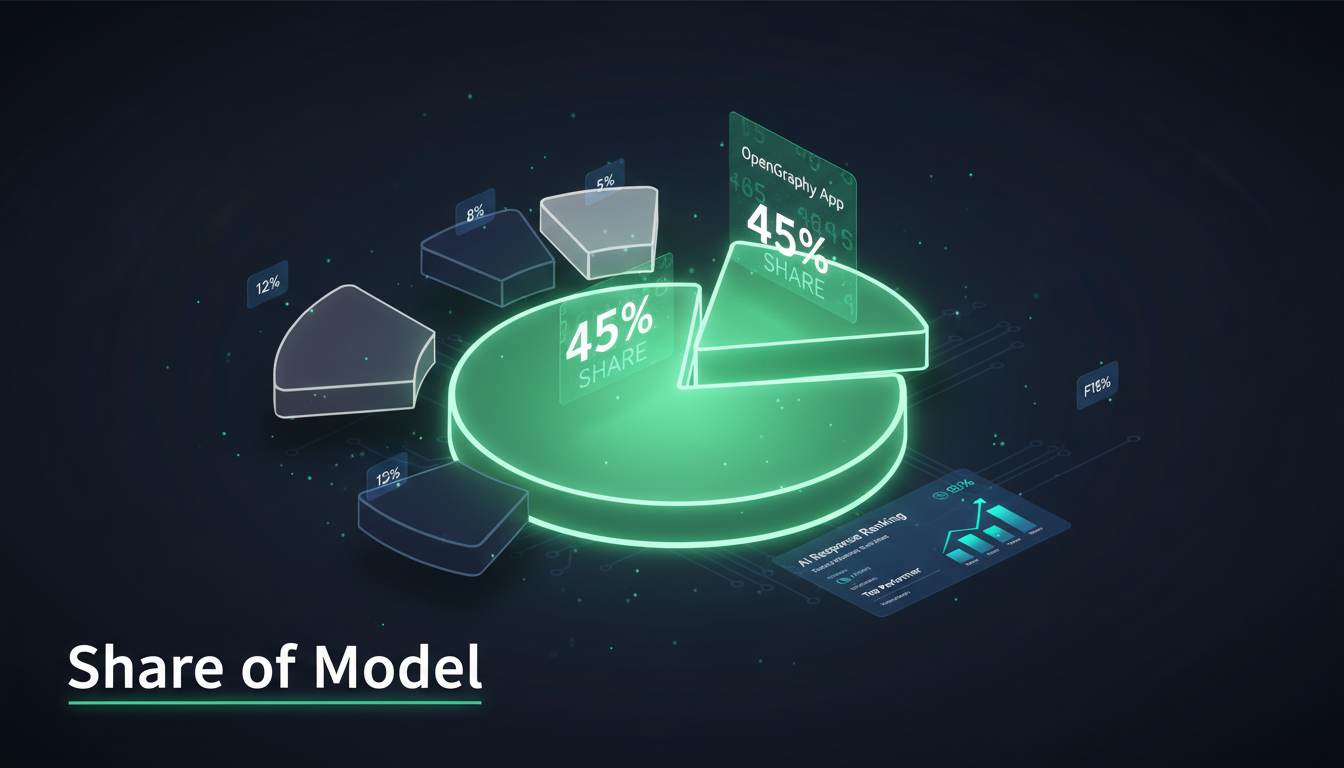
A metric measuring how often a brand is cited or recommended in AI-generated answers across multiple AI platforms, replacing traditional Share of Voice.
AI Visibility Score
A composite metric quantifying a brand's presence, authority, and favorability across AI model responses and training data.