RAG (Retrieval Augmented Generation)
A technique that enhances LLM responses by retrieving relevant information from external knowledge bases before generating answers.
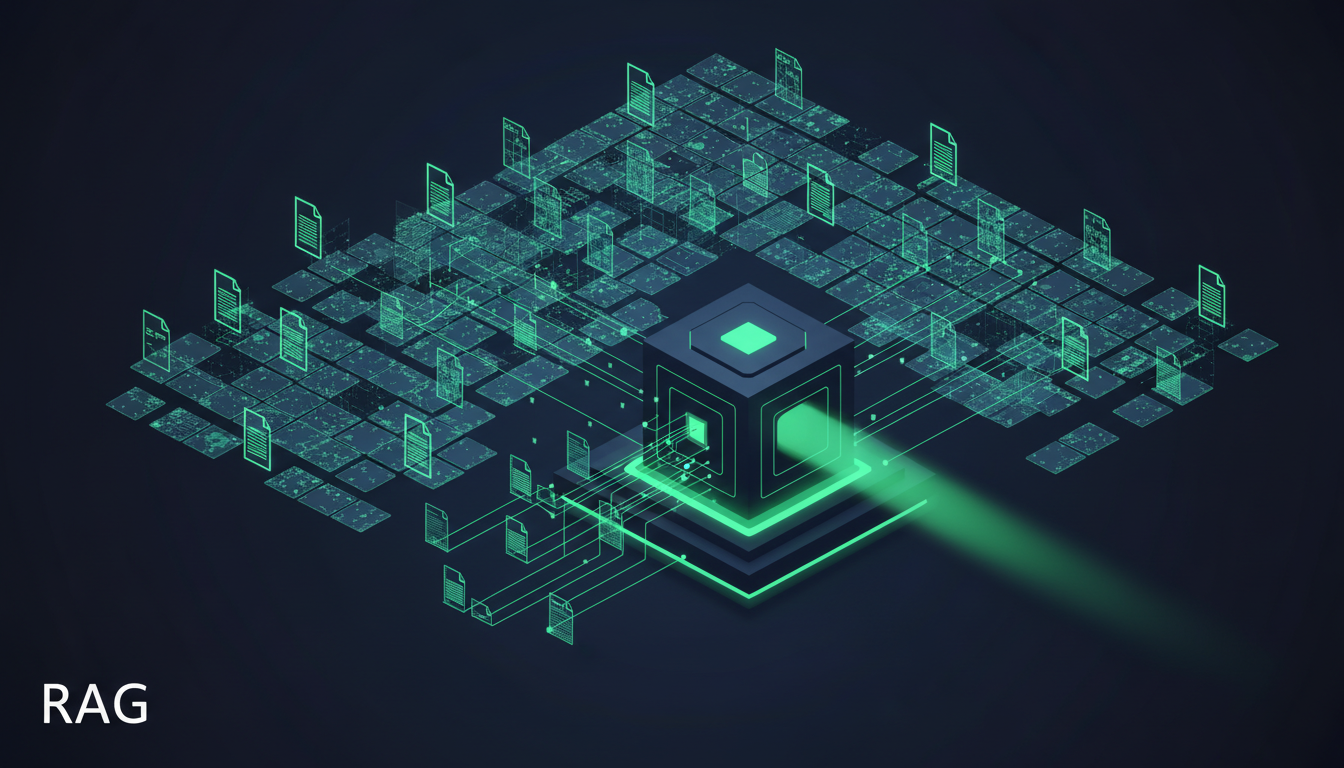
Retrieval-Augmented Generation (RAG) is the architectural pattern that lets a Large Language Model answer questions using information it never saw during training. At query time, a retrieval layer (typically vector search over embedded documents, sometimes combined with keyword search and live web fetching) pulls the most relevant chunks of source material; that material is concatenated into the prompt; the LLM generates an answer constrained to the retrieved evidence. The pattern unlocks two capabilities at once: factual freshness (the model can answer about events that happened yesterday) and factual grounding (the model is far less likely to hallucinate when it has been handed the source). For brands, RAG is the engine behind ChatGPT Search, Perplexity, AI Overviews, and most enterprise AI assistants - and the reason your latest blog post can show up in an AI answer within hours of publishing.
Key takeaways
- 1RAG combines retrieval (search) with generation (LLM) to ground answers in external, current sources.
- 2Most live AI search products - Perplexity, ChatGPT Search, AI Overviews - are RAG systems under the hood.
- 3RAG dramatically reduces hallucinations because the model answers from supplied evidence, not from memory alone.
- 4What gets retrieved is what gets cited, so RAG turns your published content into a directly addressable answer source.
- 5The retrieval layer (chunking, embeddings, ranking) often matters more than the LLM choice for answer quality.
Why RAG (Retrieval Augmented Generation) matters
RAG bridges the gap between static training data and current information, crucial for maintaining factual accuracy in AI-generated content.
When to apply RAG (Retrieval Augmented Generation)
Powering an internal AI assistant
Index your help center, product docs, and policy library so employees get authoritative answers from your sources instead of generic LLM guesses.
Capturing AI-search traffic
Publish content optimized for retrieval (clear chunks, schema, freshness signals) so engines like Perplexity and ChatGPT Search pull from your pages when users ask product questions.
Grounding AI-generated marketing copy
Run a RAG layer that retrieves approved brand facts, statistics, and claims before the model writes - so generated content is auditable and on-message.
Best practices
- Chunk content semantically (by section/topic), not by arbitrary character count, so retrieved snippets are self-contained.
- Include a clear definition or summary near the top of every page - retrieval systems weight early content heavily.
- Use schema.org markup and clean HTML structure; many retrieval systems prefer well-structured pages over PDFs.
- Refresh content regularly: many RAG systems decay scores for stale URLs, so a quarterly refresh on top pages compounds.
- Track which of your URLs get cited inside AI answers - if your content isn't surfacing, the retrieval system is invisible to your audience.
RAG (Retrieval Augmented Generation) and OGY
OpenGraphy is built around the reality that the major AI engines are RAG systems. We probe ChatGPT Search, Perplexity, Gemini, and AI Overviews with the queries your audience actually asks, capture the cited URLs, and tell you which of your pages were retrieved - and which competitor pages took your spot. If your content isn't being pulled into RAG answers, we surface the structural fixes (chunking, schema, freshness, internal links) that move you into the retrieval set. You see results in days, not training cycles. Want to see who is being retrieved for your category? Run a free OGY audit and watch the live RAG citations roll in.
See live RAG citations for your brandRAG (Retrieval Augmented Generation) in context
As AI-powered discovery replaces traditional search, understanding RAG (Retrieval Augmented Generation) is a core competency for modern brands. It sits in the AI & GenAI family of concepts and directly influences how language models like ChatGPT, Gemini, Claude, and Perplexity surface, cite, and recommend brands.
RAG (Retrieval Augmented Generation) - frequently asked questions
Quick answers to the questions people most often ask about RAG (Retrieval Augmented Generation).
Not quite. Google Search returns ranked links for a human to read. A RAG system retrieves passages and feeds them to an LLM that synthesizes a single answer. Many AI products combine both: they search the web (retrieval), then have an LLM compose a response (generation), citing the sources.
It reduces them sharply but doesn't eliminate them. The LLM can still misinterpret retrieved evidence, blend sources incorrectly, or hallucinate when retrieval fails. Production RAG systems mitigate this with citation enforcement, refusal-to-answer guardrails, and post-hoc fact-checking.
It's the most actionable surface in GEO. Live RAG engines (Perplexity, ChatGPT Search, AI Overviews) reflect new content within days, not training cycles. If your content is well-structured, freshly updated, and authoritative, it gets retrieved and cited in real time.
For internal knowledge (policies, docs, product specs), build or buy a RAG system tuned to your corpus. For external visibility, you don't need to build anything - you optimize your public content for the RAG systems Anthropic, OpenAI, Google, and Perplexity already operate.
Most failures trace to retrieval, not the LLM: bad chunking that splits ideas mid-sentence, weak embeddings that miss semantic matches, missing freshness signals, and over-reliance on a single retrieval pass. Adding a re-ranker and combining keyword with vector search usually wins more than swapping LLMs.
Run target buying-intent prompts in Perplexity, ChatGPT, and AI Overviews and inspect the cited sources. OpenGraphy's visibility audits automate this - they show you which URLs get cited per model, per query, across the major retrieval-based AI engines.
Related Terms
Large Language Model (LLM)
A neural network trained on massive text datasets to understand and generate human-like language, powering tools like ChatGPT, Claude, and Gemini.
Generative AI (GenAI)
AI systems that create new content - text, images, video, code - by learning patterns from training data rather than following explicit rules.
Token
The fundamental unit of text processing in LLMs, typically representing a word, part of a word, or punctuation mark.