
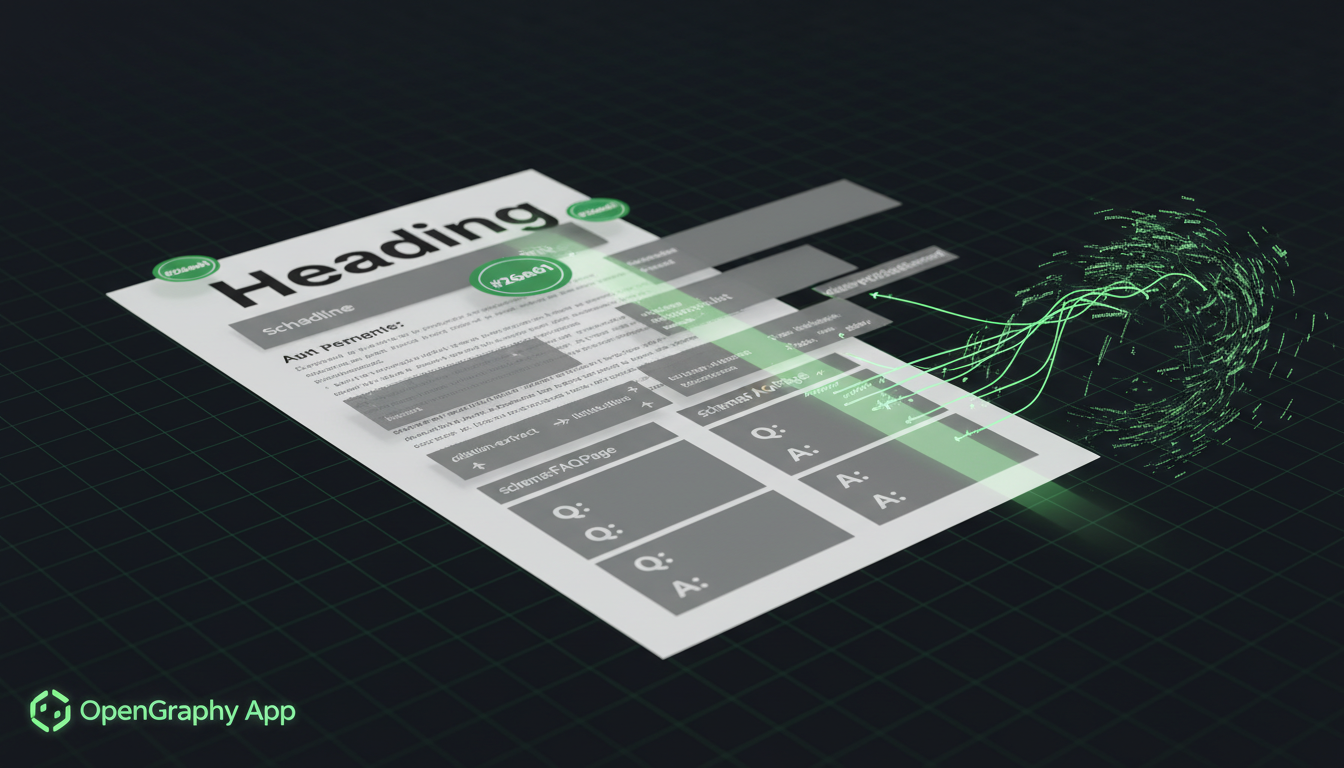
AI models extract from structured content with confidence — from prose, only with hesitation. The format choices you make in your articles determine whether ChatGPT, Claude, Perplexity and Google's AI Overviews can cleanly cite your work or have to paraphrase you cautiously. This guide is the format playbook.
"Format matters" is one of those marketing platitudes that's been true forever and only became measurably valuable in 2025. AI models read content differently from humans: they parse for headings, structured lists, FAQ blocks, schema, citations. Content that's well-organized for parsing gets cited cleanly; content that buries its answers in paragraph 7 gets paraphrased or skipped. The difference between citation and skip translates directly into AI-driven traffic and pipeline.
This guide breaks down the production-grade approach to creating structured content for AI parsing: how AI models actually parse content, the structural rules that make content extractable, the content types AI models love most, and the parseability score you should track per published article. By the end you should be able to design content that humans enjoy and AI models can cleanly cite — without choosing between the two.
How AI Models Parse Content

Content arrives at the AI model's parse layer as HTML (or the model's text representation of HTML). The parse layer scans for structural signals before reading the prose: H1, H2, H3 hierarchy; lists; tables; code blocks; FAQ blocks; schema markup. These signals tell the model where the answers are.
The two-pass parse
Most modern AI models do two passes when reading content for citation. First pass: scan structure (H2s, lists, FAQ, schema). Second pass: extract content from the relevant structural unit. Articles where the answer to the user's query lives in a clearly-marked H2 + paragraph get cited; articles where the answer is buried in paragraph 7 of an unstructured wall of text get paraphrased or skipped.
What the parse layer rewards
Question-driven H2s ("How do I..."). FAQ blocks at the end of articles. Numbered or bulleted lists for enumerable answers. Tables for comparison content. Code blocks for technical instructions. Schema markup as the explicit extraction signal.
What it penalizes
Wall-of-text prose with no headings. Vague "Section 3" headings that don't preview the content. Generic "Conclusion" or "Final Thoughts" headings. Buried answers (the actual answer to a question in paragraph 7 of a section). Inconsistent terminology across paragraphs about the same entity.
Structuring for AI Extraction

The transformation from unstructured to AI-extractable isn't about reducing prose — it's about adding scaffolding around the prose. The diptych: same insight, with and without structural scaffolding. The right side gets cited; the left side rarely does.
Question-driven H2s
The single highest-leverage structural choice. "How do I optimize for AI Overviews?" beats "Optimization." The phrasing match between your H2 and the user's query makes the content explicitly extractable. AI models running query → answer flows match against H2 phrasing first.
Structured H3 substructure
Each H2 should have 2–4 H3 sub-questions that decompose the H2's question into specific answer units. The H3 layer is what makes longer-form content remain extractable — without it, long sections become walls of prose that AI models skip.
FAQ blocks at the end
Every long-form article should end with a 5–8 question FAQ block wrapped in FAQPage schema. AI Overviews and ChatGPT extract from FAQ blocks heavily — often more than from the main article body. See Schema Markup in the AI Era.
TL;DR blocks
A 60–100 word summary at the top of long articles. This is the chunk AI Overviews most often quote when citing your page. Without it, the model picks an arbitrary paragraph; with it, you control the citation.
Bullet and numbered lists
For enumerable answers (5 best practices, 4 ranking factors, 3 stages of rollout), use lists. AI models extract list items individually with high confidence; the same content as paragraph prose has to be parsed for enumeration.
Content Types That AI Models Love

Five content types over-perform consistently across AI models. Bias your editorial calendar toward these formats.
How-to guides
Procedural content with numbered steps, prerequisites, and expected outcomes. Wraps cleanly in HowTo schema. AI models cite how-to content heavily for procedural queries.
Comparisons
"X vs Y" content with structured tables comparing features, pricing, use cases. Wraps in Article + structured comparison data. The single highest-leverage co-occurrence builder; see How AI Models Reveal Your Hidden Competitors.
FAQs
Question-and-answer pages on focused topics. Wraps in FAQPage schema. AI Overviews extract from FAQs more often than from any other format.
Definitions and reference content
"What is X?" content that establishes you as the canonical source for the term or concept. Pairs with Article schema and entity linking. Strong long-tail traffic compounder.
Step lists
Numbered steps with structured outputs at each stage. Different from how-to in being more granular and procedural. Wraps in HowTo schema. Excellent for tutorial content.
Measuring AI Parseability

You can score every published article on parse-readiness. The OpenGraphy Parseability Score tracks four dimensions on a 0–100 scale.
Heading depth
Count of H2s + (H3s × 0.5) + (H4s × 0.25). Articles with at least 5 H2s and 8+ H3s score well. The depth signals the parse layer that the content is well-organized.
List density
Count of bulleted and numbered lists per 1,000 words. Articles with 4+ lists per 1,000 words score well. Lists are extracted with high confidence.
FAQ block presence
Binary: does the article end with a FAQPage-schema-wrapped FAQ block? Articles without FAQ blocks score significantly lower; FAQ presence is the single highest-impact structural fix.
Code samples and tables
For technical content: count of code blocks and structured tables. Each adds parseability points; both signal authoritative reference content.
What "AI-Ready" looks like
A Parseability Score of 90+ correlates with measurably higher citation frequency in stress tests. Most generic AI content scores 40–60; targeted optimization moves it to 85–95.
FAQ: Structured Content for AI
What is structured content for AI parsing?
Content organized with explicit structural markers (H2/H3 hierarchy, lists, tables, FAQ blocks, schema markup) so AI models can parse and cite it cleanly. Different from generic well-written content because the optimization target is the model's parse layer, not just the human reader.
Will structuring content for AI hurt human readability?
No — well-structured content is more readable for humans too. The same patterns (clear H2s, scannable lists, FAQ blocks) help both audiences. Tension only appears when teams over-optimize for parseability at the expense of voice; the right balance produces content both audiences enjoy.
How long should articles be?
For B2B authority content: 1,500–2,500 words is the sweet spot. Long enough to demonstrate depth, short enough that structure remains tight. Beyond 3,000 words, parseability tends to drop unless H3 substructure is dense.
What schema should I always include?
Article + FAQPage as the floor. Add HowTo for procedural content, Comparison or Product for evaluation content, Author/Person schema for the byline. The OpenGraphy Schema Builder auto-generates the right combination.
How do I measure parseability?
Track the four-dimension Parseability Score per article: heading depth, list density, FAQ presence, code/table count. Aim for 90+ on priority pillar content; accept lower scores on shorter posts where the format doesn't warrant deep structure.
Does structured content matter as much for ChatGPT as for Google AI Overviews?
Yes — and possibly more. ChatGPT extracts heavily from FAQ blocks and structured H2 hierarchies. Google AI Overviews favor schema completeness slightly more. Both reward the same patterns; rare to optimize for one and lose ground on the other.
Going Further
- Schema Markup in the AI Era — the schema layer that powers extractability.
- Optimizing for Google AI Overviews — Google-specific format rules.
- Creating AI Content That Actually Ranks — the broader quality framework.
- Using Templates to 10x Content Productivity — templates that lock structural patterns.
- How to Rank in AI-Generated Lists — the citation-rate playbook.
Ready to put this into action?
Explore our Content features and start optimizing today