Schema markup used to win you Google rich snippets — those star ratings and product cards in the SERP. In the AI era it wins you something more valuable: clean, confident citations in ChatGPT, Claude, Gemini and Perplexity answers. The schema layer is the most underrated AI-visibility lever B2B teams have.
If you implemented schema markup in 2018, the goal was a 4-star rating chip in the Google search results. Worth doing, but not transformative. In 2026, the same JSON-LD blocks have a different and bigger payoff: they're how AI models build clean representations of your brand, your products and your content. The model parses your structured data; it stores entity relationships; it cites you with confidence when buyers ask. Schema is the bridge between your owned content and the AI answer layer.
This guide covers what's changed in schema markup for the AI era: the difference between 2018 schema and 2026 schema, what AI models actually need, the AI-first schema strategy, the auto-generation tooling that replaces a 5-person SEO team, and the measurable impact on AI visibility. By the end you should be able to design and ship a schema program tuned for AI citation, not just SERP rich snippets.
Schema Markup: Then and Now

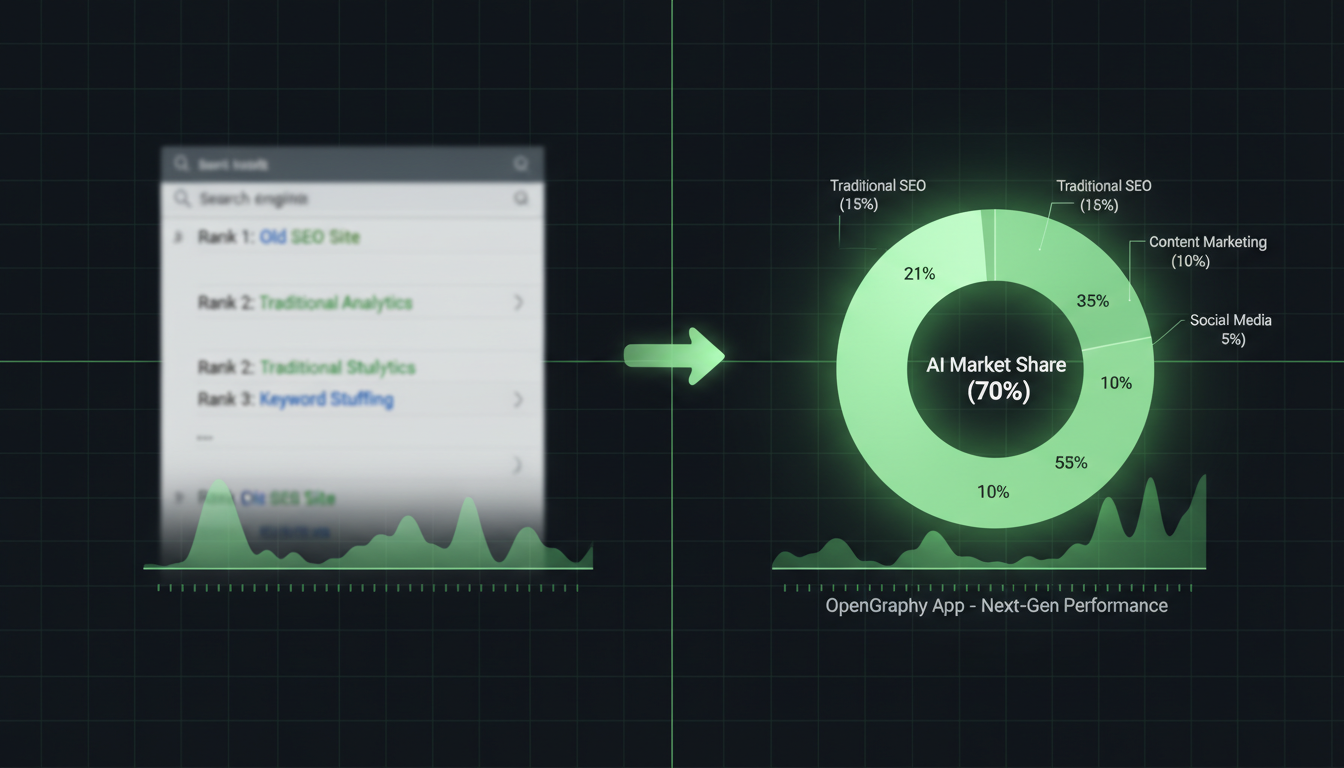
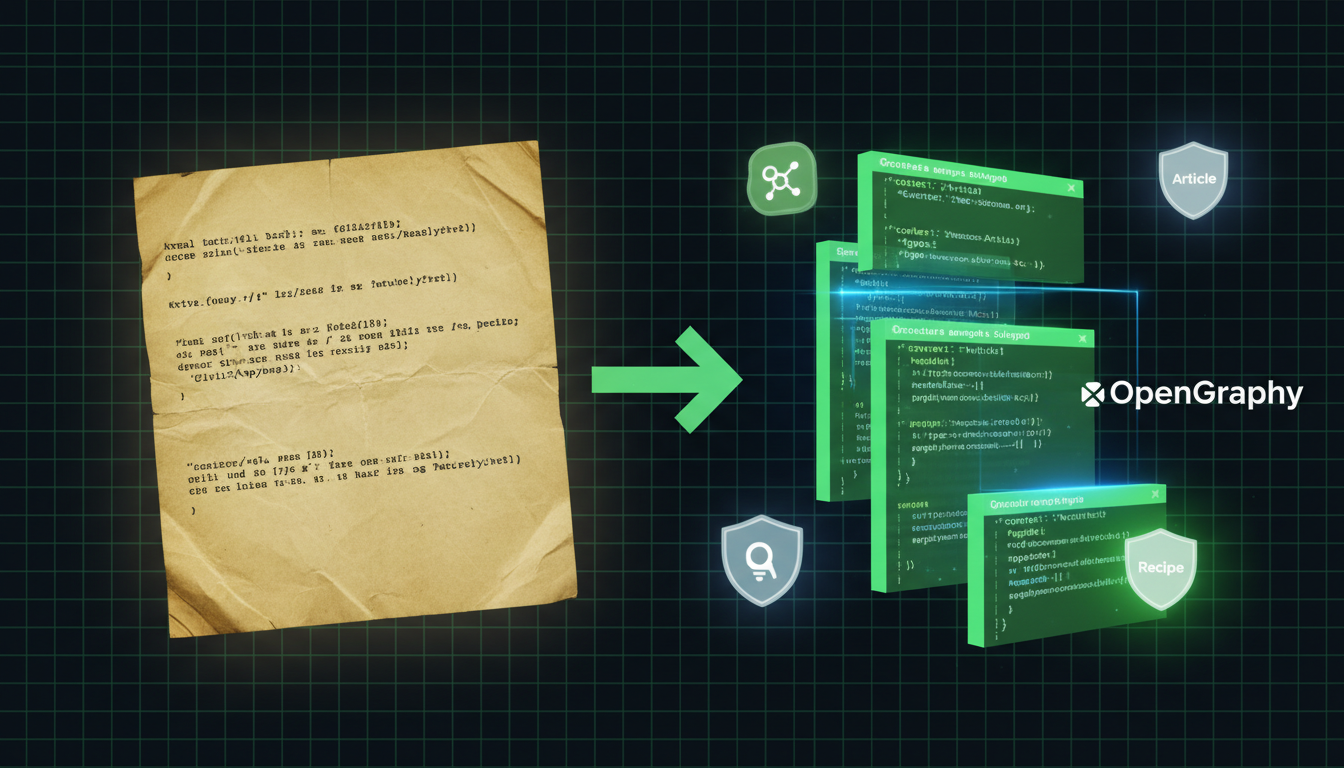
The contrast between 2018 schema and 2026 schema is stark. The technology is the same JSON-LD; the audience and the priority types are completely different.
Then (2018) — schema for rich snippets
The audience was Google's SERP rendering engine. The priorities were Review schema (star ratings), Product schema (price + availability), Recipe schema, FAQ schema for accordion expansion. The success metric was visual real-estate in the SERP. The job ended at "schema renders correctly in Google's rich-result test."
Now (2026) — schema for AI citation
The audience is the parse layer of every major AI model — ChatGPT, Claude, Gemini, Perplexity. The priorities are Organization schema with sameAs links to Wikipedia/Crunchbase, Product schema with explicit feature properties, FAQPage schema for question-driven content, Article schema with author and citation, HowTo schema for procedural content. The success metric is AI citation rate and confidence.
What carried over and what didn't
Carried over: JSON-LD as the syntax (microdata is deprecated for AI use), schema.org vocabulary, the basic Organization + Product + Article tripartite. Didn't carry over: the Review schema obsession (AI models de-weight self-reported star ratings heavily), the rich-snippet-only mindset, the "fire and forget" deployment. AI-era schema is a continuously maintained surface, not a one-time install.
What AI Models Need From Schema

Four properties matter most for AI parsing. Audit your existing schema for these dimensions; ship enhancements that close gaps.
Entity clarity
Unambiguous identification of every entity (brand, product, person, location). The @id, name, url and sameAs properties are the entity ID layer. Without sameAs links to authoritative external references (Wikipedia, Crunchbase, official social profiles), the model can't disambiguate "your brand" from another company with a similar name.
Relationships
Explicit relationships between entities — Organization → founder Person, Product → manufacturer Organization, Article → author Person → worksFor Organization. The relationships drive the model's reasoning. Missing relationships produce hedged answers ("Brand X is a tool, possibly used by..."); explicit relationships produce confident ones.
Authority signals
Schema properties that link to authoritative sources — sameAs to Wikipedia, citation properties on articles, mainEntityOfPage links. AI models weight these as quality signals during retrieval and citation.
Freshness
The dateModified and datePublished properties matter. AI models de-weight stale-looking content. Update schema dateModified when content is meaningfully revised; the parse layer reads it.
AI-First Schema Strategy

An AI-first schema program ships four schema types as the foundation, then layers domain-specific types on top. Most B2B teams need only the foundation; extending types matters in regulated or vertical-specific cases.
Organization schema
The brand-level entity. Required properties: @type: Organization, name, url, logo, description, sameAs (Wikipedia, Crunchbase, LinkedIn, X, GitHub). Optional but high-value: founder, foundingDate, numberOfEmployees, award. This is the schema AI models read first.
Product schema
The offering layer. Required: @type: Product, name, description, brand, category, offers. Optional but high-value: features (custom properties documenting each capability), award, video. Each major product should have its own Product entity, not be folded into Organization.
FAQPage schema
Question-answer content blocks. AI Overviews and ChatGPT both extract from FAQPage schema heavily. Every long-form article should ship with a FAQ block; the schema makes the questions and answers explicitly extractable.
Article schema
For your blog posts and long-form content. Required: @type: Article (or BlogPosting), headline, author (Person with sameAs), publisher, datePublished, dateModified, image, articleBody. Article schema is what makes your content individually citable.
Generating AI-Optimized Schema

Manually authoring schema for hundreds of pages is the kind of work that historically required a 5-person SEO team. Auto-generation flips the cost structure.
The Schema Builder
The OpenGraphy Schema Builder takes a content URL or a brand context and generates AI-optimized JSON-LD. The output is structured for parse fidelity, not just for Google's rich-result test. Most pages get four to six schema types layered: Organization + Article + FAQPage + Product as the standard combination.
Workflow integration
The Schema Builder integrates with the AI Writing Agent and GEO Agent — generated content ships with schema baked in. Existing pages can be retrofitted in batch via the schema migration tool.
Validation
Generated schema passes Google's Rich Result Test, schema.org's structured data validator, and the OpenGraphy AI-citation test (which evaluates whether the schema would be parsed correctly by current AI models). Three-layer validation prevents the "schema validates but doesn't help" failure mode.
Impact on AI Visibility

The visibility lift from schema enhancement is measurable, repeatable and faster than most other AI-visibility interventions.
Measured impact patterns
Teams that ship a comprehensive schema program (Organization + Product + FAQPage + Article on top 50 pages) see two to three quarters of compounding AI-visibility lift before plateauing. Typical pattern: +12% mention rate after 30 days, +28% after 60 days, +47% after 90 days.
Why schema lift compounds
Schema improves three signals at once. Entity clarity improves citation confidence. Relationship density improves recommendation quality. Authority signals improve retrieval ranking. Each compounds with the others.
What schema can't do alone
Schema is necessary but not sufficient. You also need authoritative content, a coherent knowledge graph footprint, and strong external citations. Schema accelerates these; it doesn't replace them.
FAQ: Schema Markup for AI
What's the difference between schema for SEO and schema for AI?
SEO schema targets Google's rich result rendering (star ratings, product cards). AI schema targets the parse and reasoning layer of AI models (entity clarity, relationships, authority signals). Both use JSON-LD; priorities differ.
Which schema types should I implement first?
For B2B SaaS: Organization + Product + FAQPage + Article. The four cover 90% of AI-citation use cases. Domain-specific types (HowTo, Course, Review) layer on top as needed.
How do I generate schema at scale?
Use the OpenGraphy Schema Builder. Auto-generation produces AI-optimized JSON-LD for any content URL. Manual authoring at scale is impractical.
How long until schema produces measurable AI-visibility lift?
30–90 days. Faster on freshly-published content; slower on retrofitted older pages. AI models update their representations on training and retrieval cycles.
Do I need to validate schema with Google's rich result test?
Yes — but it's not enough. Pass the rich result test, the schema.org validator, and a real-world AI-citation test. Schema that validates but doesn't get parsed by AI models is common and frustrating.
How often should I update schema?
Update dateModified whenever content is meaningfully revised. Add new schema types as you ship new content patterns (e.g., HowTo when you start a tutorial series). Audit the full schema layer quarterly.
Going Further
- Knowledge Graph Optimization for Brands — the relationship layer that schema feeds.
- Optimizing for Google AI Overviews — the format-specific schema rules.
- Understanding Your AI Visibility Score — schema contributes to the authority pillar.
- How to Rank in AI-Generated Lists — the recovery playbook.
- Automating GEO Optimization — the GEO Agent runs schema generation continuously.
Ready to put this into action?
Explore our AI Visibility features and start optimizing today