Google AI Overviews now answer more than 30% of B2B search queries above the fold — synthesized answers with three or four citation chips, appearing before any traditional blue link. Being one of those citation chips is the new top-of-funnel goal. This guide covers exactly how to get there.
The shift from blue-link SERPs to AI-Overview answers is the largest change to Google search since Universal Search in 2007. For B2B brands, the implications are significant: a buyer asking "best AI SEO platform" or "how to track competitor AI mentions" increasingly gets a synthesized answer with three citation links — and never scrolls to the organic results below. If your content isn't one of those citations, you didn't lose the keyword ranking; you lost the visit entirely.
This guide covers the production-grade approach to AI Overviews optimization: what AI Overviews actually are, how Google selects sources, the four-stage optimization strategy, the content format rules that win citations, and the measurement loop that tells you whether your work is paying off. By the end you should be able to operate an AI Overviews optimization program that produces citation lift quarter over quarter.
What Are AI Overviews?

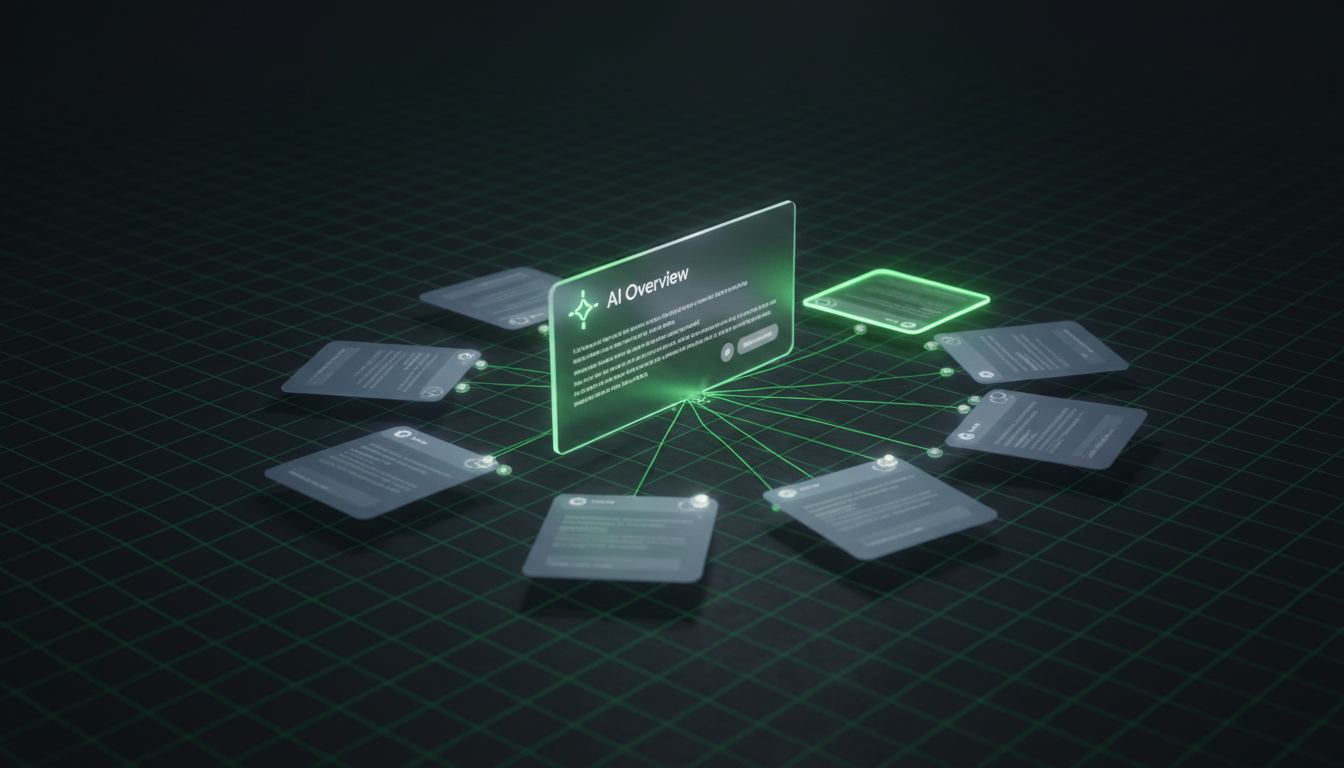
AI Overviews are Google's synthesized answer panel that appears at the top of search results for queries Google determines benefit from a generated summary. The panel composes a multi-paragraph answer from multiple sources, with three to four cited links visible as chips.
What triggers an AI Overview
Three patterns dominate. Question queries ("how to," "what is," "why does"). Comparison queries ("X vs Y," "alternatives to Z"). List queries ("best tools for," "top alternatives to"). B2B queries map heavily onto these patterns, which is why AI Overviews matter disproportionately for B2B vs. e-commerce.
How AI Overviews change buyer behavior
The Overview answers the question. The user no longer has to click through to multiple sites. Click-through rates on traditional organic results below the Overview have dropped 30–60% in B2B categories. Citation in the Overview itself is the new traffic-acquisition objective.
How they differ from Featured Snippets
Featured snippets quote a single source. AI Overviews synthesize multiple sources into a generated answer. Snippets quoted you verbatim; Overviews paraphrase you and credit you with a chip. Different mechanic, different optimization rules.
How Google Selects Sources for AI Overviews

Google's source selection for AI Overviews uses four primary signals. Optimize for all four; don't over-index on any one.
Authority
The page's authority footprint — backlink profile, brand recognition, mention frequency in trusted sources. The classic SEO signals still matter; they just don't operate alone anymore.
Freshness
How recent is the content? AI Overviews lean toward fresh sources for queries where currency matters (technology, industry trends, ongoing events). The dateModified schema property is parsed.
Structured data
Schema markup, especially FAQPage and Article schema, makes content explicitly extractable. Pages with strong schema are massively favored in AI Overview source selection. See Schema Markup in the AI Era.
Topic relevance
The depth and specificity of the content's coverage of the query topic. Generic posts that touch the topic lose to focused posts that own it. Cocon-sémantique structures (a pillar plus tightly linked supporting articles) compound topic relevance.
Optimization Strategy

Four-stage strategy. Most B2B teams ship the first cycle in 4–6 weeks; subsequent cycles compound.
Stage 1 — Target questions
Identify the buyer questions you want to be cited on. Use stress tests to surface which queries currently produce AI Overviews and which sources are cited. The first batch is the priority list.
Stage 2 — Structured answers
For each target question, create content that directly answers it in the first 100 words. AI Overviews extract from clear, structured answers — not from buried-in-paragraph-7 explanations. Lead with the answer; expand with context below.
Stage 3 — Add schema
Wrap question-and-answer content in FAQPage schema. Wrap pillar articles in Article schema with proper author and publisher attribution. The schema layer is what makes content explicitly extractable. The GEO Agent automates this stage.
Stage 4 — Cite authority
Link to authoritative sources from your content. AI Overviews favor sources that themselves cite well. Original data, third-party studies, industry reports — citing these signals authority back to your page.
Content Format Best Practices

Four format rules differentiate AI-Overview-friendly content from generic long-form.
Question-driven H2s
Headings phrased as the questions buyers ask. "How do I optimize for AI Overviews?" beats "Optimization." The phrasing match makes the content explicitly extractable when the model parses the page for an answer.
Bullet answers
For list-type queries, structured bullet lists with consistent formatting are extracted more cleanly than prose paragraphs. The "best 5 X tools" pattern works because each bullet is a clean answer unit.
TL;DR block
A 60–100 word summary block at the top of long articles. This is the chunk AI Overviews most often quote when citing your page. Without it, the model picks an arbitrary paragraph; with it, you control the citation.
FAQ schema
Every long-form article should end with a 5–8 question FAQ block wrapped in FAQPage schema. AI Overviews extract from FAQ blocks heavily — often more than from the main article body.
FAQ: AI Overviews Optimization
What is a Google AI Overview?
Google's synthesized answer panel that appears at the top of search results for queries that benefit from a generated summary. Composes a multi-paragraph answer from multiple sources with three to four cited links.
How is AI Overview optimization different from traditional SEO?
Traditional SEO optimizes for ranking position. AI Overview optimization optimizes for being one of the cited sources in a synthesized answer. Schema completeness, structured answers and topic specificity matter more than backlinks alone.
Which queries trigger AI Overviews?
Question queries, comparison queries and list queries trigger AI Overviews most often. B2B queries map heavily onto these patterns, which is why B2B brands see AI Overview impact more than most categories.
How long until optimization shows results?
30–60 days for measurable lift. Faster on fresh content with strong schema; slower on retrofitted older pages. The GEO Agent can identify and ship fixes continuously.
Can I be cited if I don't rank in the top 10 organic?
Yes — and frequently. AI Overviews source selection isn't tied to organic ranking. Content that's structured for extraction can be cited even if it ranks #25 organically.
How do I track AI Overview citations?
Use stress tests on your priority queries to track citation appearance over time. The AI Positions dashboard surfaces citation frequency per query per model.
Going Further
- Schema Markup in the AI Era — the schema layer that powers AI Overviews citation.
- Creating Structured Content for AI Parsing — content-format rules in depth.
- How to Rank in AI-Generated Lists — the broader AI-citation playbook.
- Understanding Your AI Visibility Score — AI Overviews contribute to the visibility score.
- Automating GEO Optimization — the agent that runs Overviews optimization continuously.
Ready to put this into action?
Explore our AI Visibility features and start optimizing today