
If your brand is invisible in ChatGPT, Claude, Gemini and Perplexity, your buyers are quietly evaluating competitors instead of you. The OpenGraphy AI Visibility Score is the single number that tells you where you stand — and the diagnostics underneath tell you what to do about it.
For most B2B teams in 2026, "where do we rank?" is now a question with two answers. Ranking on Google still matters, but it's a fraction of the picture. The other half of buyer journeys runs through AI assistants, and the metric for that half is the AI Visibility Score. Treating it as a single rolled-up KPI lets your leadership team track AI presence the way they track Google ranking — at a glance, with the underlying levers visible when needed.
This guide covers the AI Visibility Score in depth: what it is, the five pillars that compose it, how to interpret your score, the strategies to improve each pillar, why traditional SEO alone doesn't move it, and the path from "first audit" to "structural visibility lift." By the end you should be able to integrate the score into your monthly KPI rhythm and operate against it.
What Is the AI Visibility Score?

The AI Visibility Score is a unified metric — typically rendered on a 0–100 scale — that measures how well your brand performs across AI answer engines. It rolls up multiple sub-dimensions into a single number designed for executive dashboards while preserving access to the underlying diagnostics.
What it measures
Five dimensions: Frequency (how often AI models mention your brand on priority queries), Accuracy (how factually correct those mentions are), Sentiment (how positively your brand is described), Authority (how confidently the model cites you), and Coverage (the breadth of queries you appear on).
What a "good" score looks like
For B2B SaaS in established categories, 60–75 is the typical operating range. Above 80 indicates structural advantage; below 50 indicates significant invisibility. The score normalizes for category competitiveness, so comparisons across industries are meaningful.
How it's calculated
Continuous stress tests on a curated query set (typically 30–80 queries) across all four major AI models. The five sub-dimensions are weighted and rolled up. Scores update on each test cycle; trend matters more than absolute level.
The Five Pillars of AI Visibility

The score's diagnostic value comes from decomposition. Each pillar has its own optimization playbook.
Frequency — how often you're mentioned
The foundation. If you're not mentioned at all on a category query, every other pillar is moot. Frequency is driven by training-corpus coverage, schema completeness, and continuous fresh-content shipping.
Accuracy — how correct the mentions are
Wrong pricing, wrong feature attribution, wrong customer base. Accuracy issues compound because AI models cite each other. Fix at the source — Wikipedia, Crunchbase, your owned content — and the corrections propagate.
Sentiment — how you're described
Positive, neutral or negative framing across mentions. Driven by review-site sentiment, public discussion patterns, customer success content. See Monitoring Brand Sentiment in AI Responses.
Authority — citation confidence
Does the AI model cite you with confidence ("X is the leading platform for Y") or hedge ("X may be useful for Y")? Authority is driven by entity clarity, sameAs links to authoritative sources, and citation density from trusted publications.
Coverage — breadth of presence
Number of distinct queries on which you appear. A brand can score high on its top-3 priority queries and zero on the next 30. Coverage measures the breadth — and broad coverage is what compounds long-tail AI traffic.
How to Improve Your Score

Four levers move the score; pull them in the order most likely to compound.
Schema first
The fastest-acting lever. Comprehensive schema markup (Organization, Product, FAQPage, Article) on top-50 priority pages produces 30-day measurable lift. The Schema Builder auto-generates AI-optimized JSON-LD. See Schema Markup in the AI Era.
Entity clarity second
Clean up your brand's knowledge graph footprint. sameAs links to Wikipedia/Crunchbase/LinkedIn, consistent brand naming across sources, explicit founder-and-product entities. The Knowledge Graph Engine surfaces gaps; the GEO Agent ships fixes.
Authority third
Original research, prominent guest posts, analyst-firm relationships. Slowest-acting but longest-compounding lever. Most B2B teams under-invest here; teams that invest see structural lift over 6–12 months.
Coverage fourth
Continuous content shipping targeting under-covered queries. The AI Writing Agent can ship targeted authority articles for invisible queries. Cadence (3+ pillar articles per month) compounds coverage faster than one-off heroic posts.
Why Traditional SEO Isn't Enough

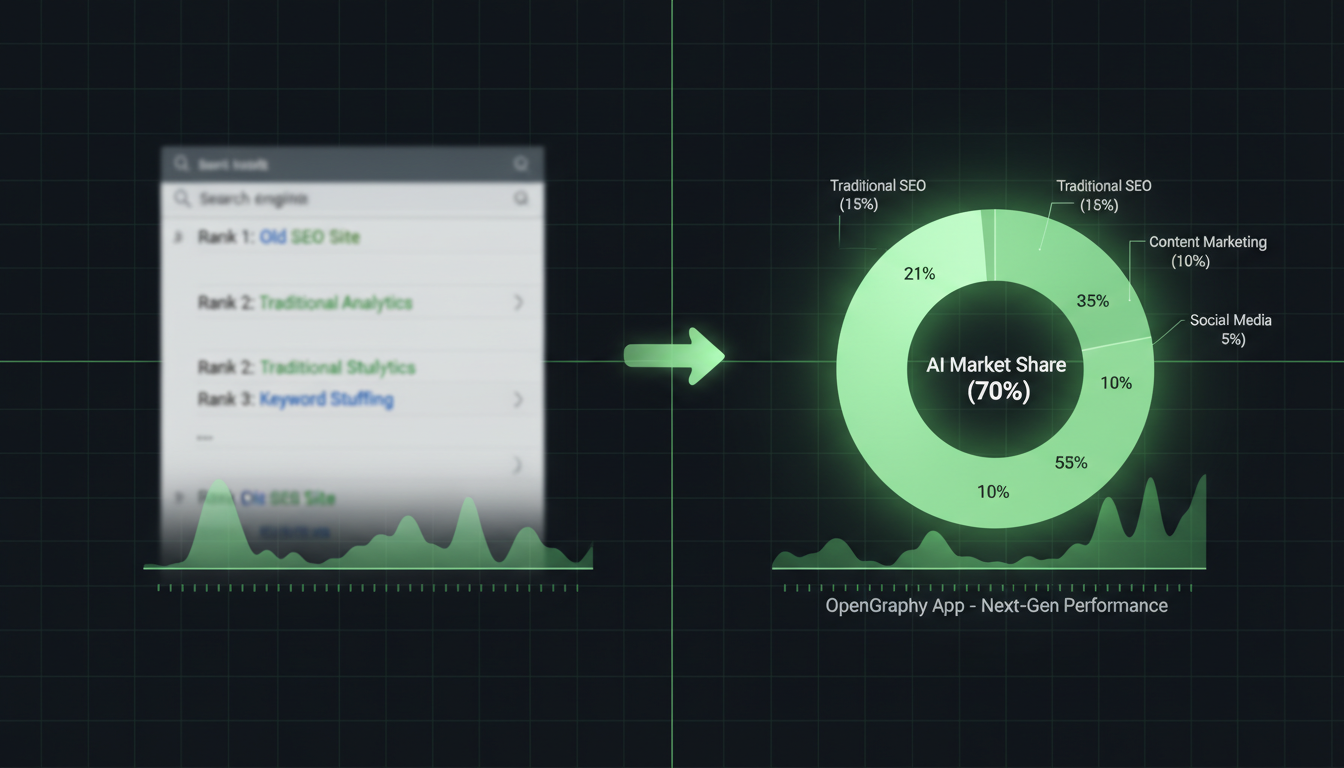
Traditional SEO and AI visibility share inputs (content, schema, authority) but optimize for different objectives. The mismatch is why teams ranking #1 on Google sometimes find themselves invisible in ChatGPT, and vice versa.
What SEO optimizes for
The Google ranking algorithm: backlinks, page-level keyword relevance, click-through rate from SERPs. The unit of victory is a top-3 organic position.
What AI visibility optimizes for
The synthesis layer of AI models: entity clarity, citation confidence, schema completeness, training-corpus coverage. The unit of victory is being a cited source in an AI answer.
The overlap and the gap
Strong owned content with good schema serves both. But: AI Overviews (now 30%+ of B2B searches) are eating click-through; AI assistants don't read SERPs at all; comparison content matters disproportionately for AI list ranking but often ranks poorly on Google. Treating AI visibility as a separate optimization surface — with its own metrics and tooling — is the right approach.
Getting Started

The on-ramp is structured: audit, prioritize, ship, measure. Most B2B teams complete the first cycle in 4–6 weeks.
Week 1 — baseline audit
Run a comprehensive stress test across 30–80 priority queries. The output is your starting AI Visibility Score plus the per-pillar diagnostic. Identify the lowest-scoring pillar.
Week 2–4 — first round of fixes
Schema audit and ship: top 30 pages get full Organization + Article + FAQPage schema. Knowledge graph audit and fix: cleanest entity definitions, sameAs links to authoritative sources. The GEO Agent automates most of this.
Week 4–8 — content cadence
Begin shipping 2–4 authority articles per month targeting under-covered queries. Comparison content where co-occurrence is missing. Original data studies if budget allows.
Week 8 onwards — measure and iterate
Re-run stress tests monthly. Track score trend. Promote the patterns that work; rotate out what doesn't. The compounding gain takes 6–12 months to mature; the pattern is consistent.
FAQ: AI Visibility Score
What is the AI Visibility Score?
A unified 0–100 metric that measures how well your brand performs across AI answer engines (ChatGPT, Claude, Gemini, Perplexity). Composed of five sub-dimensions: frequency, accuracy, sentiment, authority, coverage.
How is it different from a Google ranking?
Google ranking measures organic position in blue-link results. AI Visibility Score measures presence and quality in AI-synthesized answers. Different surfaces, different optimization rules, different downstream behaviors.
What's a good score?
For B2B SaaS in established categories: 60–75 typical operating range, 80+ structural advantage, <50 significant invisibility. Score is normalized for category competitiveness.
How often does the score update?
Each stress test cycle. Most teams configure weekly testing for competitive categories, monthly minimum for stable ones. The trend matters more than absolute level.
Which pillar should I optimize first?
Schema completeness usually has the fastest payoff (30–60 day lift). Entity clarity has the most durable payoff. Authority has the highest ceiling but the longest lag. Most teams run all three in parallel.
Can I improve my score without more content?
Partially. Schema and entity clarity move the score without new content. Sustained lift requires continuous fresh-content shipping. Both are needed; fresh content compounds faster when paired with schema and KG fixes.
Going Further
- Share of Model: The New Market Share Metric — the headline competitive metric.
- Stress Testing Your AI Presence — the measurement methodology.
- Schema Markup in the AI Era — the highest-leverage lever.
- Knowledge Graph Optimization for Brands — the entity layer.
- Automating GEO Optimization — the agent that drives all five pillars.
Ready to put this into action?
Explore our AI Visibility features and start optimizing today