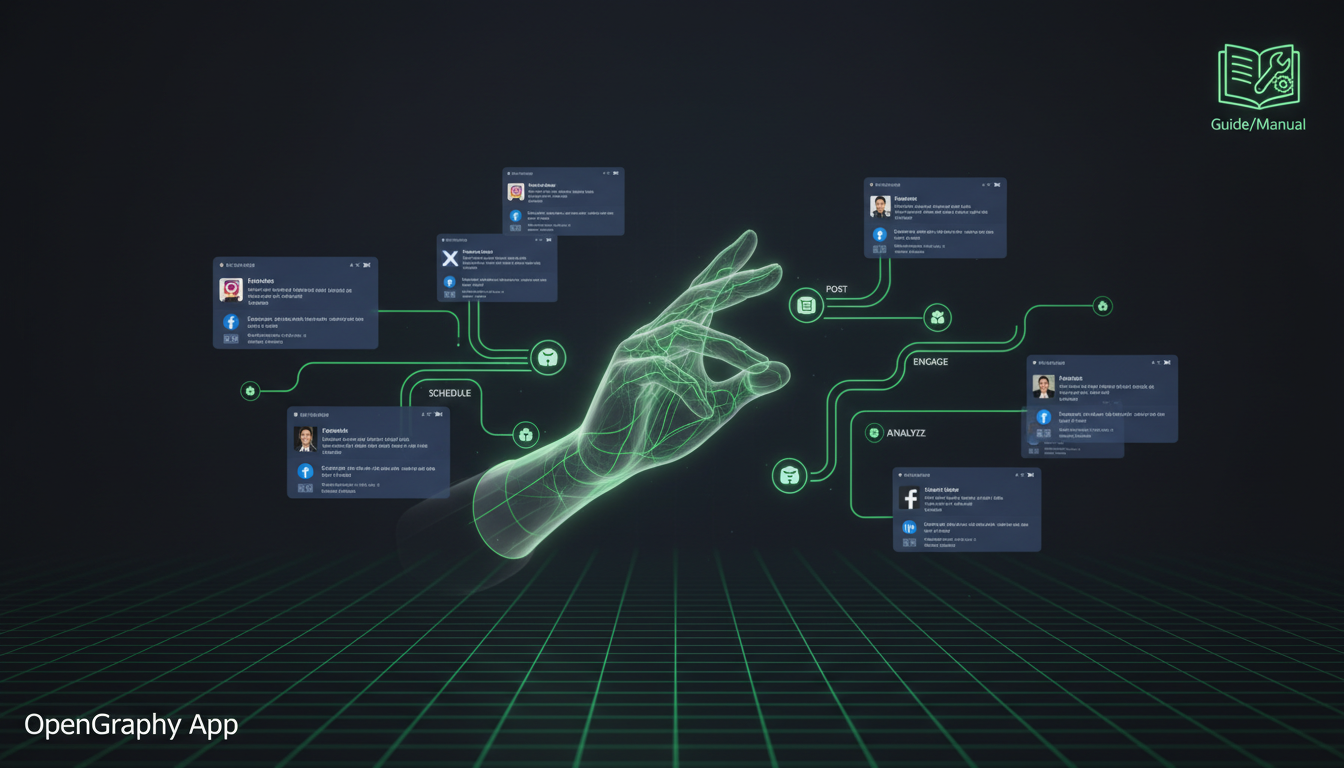
Social is the highest-volume content channel and the lowest-leverage place to spend a marketer's time. The OpenGraphy Social Agent stack — paired with Scheduler and Publishing — runs your social calendar end-to-end while preserving the brand voice your audience trusts.
Most B2B teams have a love-hate relationship with social media. Volume requirements keep climbing — LinkedIn alone wants 5–7 posts per week per Company Page — while the marginal ROI of each post is small relative to the time it takes to produce. That's the structural problem an agent stack solves: the volume becomes free, attention shifts to strategy and editorial direction.
This guide walks through the complete social media automation playbook: the agent stack, the platform-by-platform format rules, the brand-voice controls that prevent generic AI output, the staged rollout from assisted to fully autonomous, and the KPIs that tell you whether the system is actually working. By the end, a small marketing team should be able to sustain a 30+ post-per-week cadence across 4 channels with under 2 hours of weekly review.
The Social Automation Stack

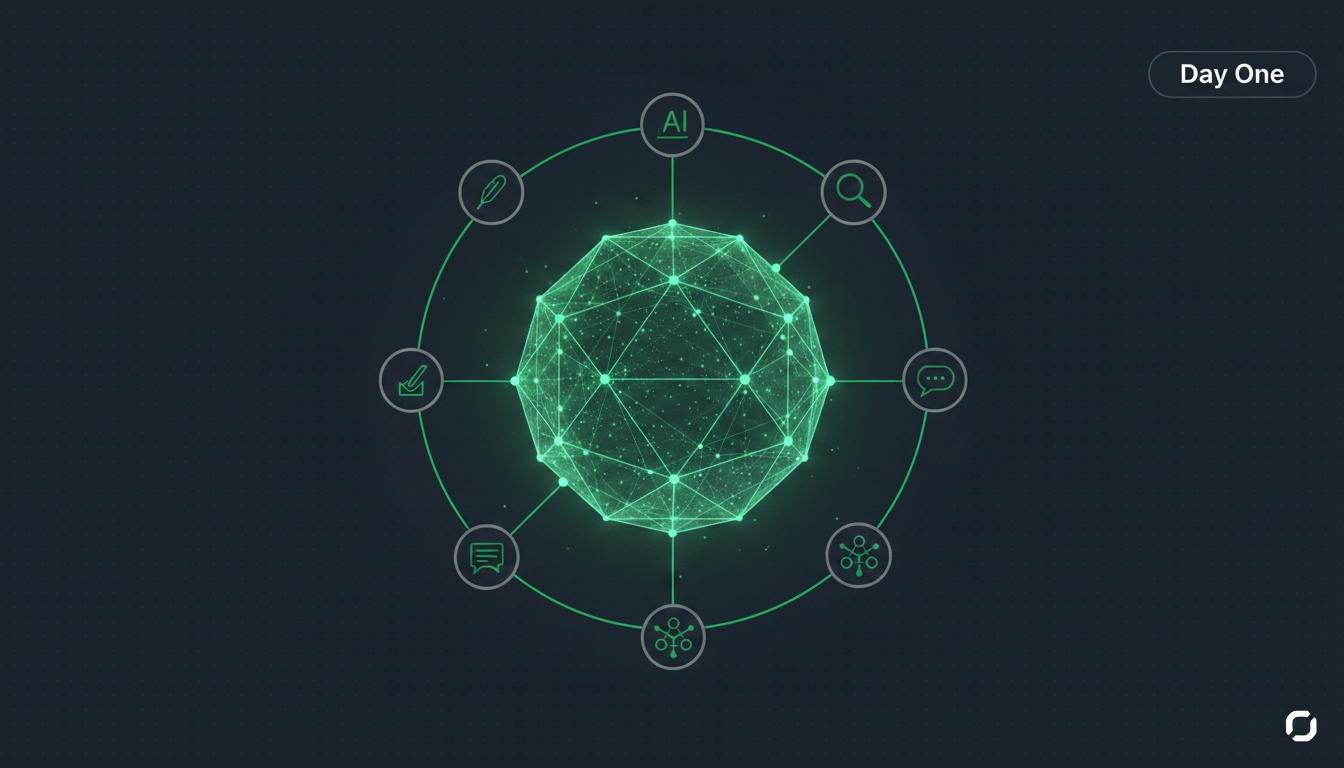
Social automation isn't a single tool — it's a layered stack of specialized agents and generators, each handling one part of the pipeline. The composition matters as much as the individual capabilities.
Layer 1 — Social Agent (creation)
The Social Agent turns a brief (or an upstream pillar article) into platform-native posts. It writes the copy, picks the format (text post, carousel, thread, Reel script), inserts the right hashtags and adjusts length to platform norms. Brand DNA injection ensures every output sounds like your brand.
Layer 2 — Scheduler Agent (timing)
The Scheduler Agent takes the generated posts and assigns optimal slots across the week, factoring audience activity heatmaps and channel-specific algorithm rules. See AI-Powered Content Scheduling Strategies for the timing logic.
Layer 3 — Publishing Agent (distribution)
When a slot fires, the Publishing Agent pushes to LinkedIn, X, Instagram, Facebook, YouTube and TikTok with platform-correct adaptations — aspect ratios, link handling, hashtag placement. See Multi-Channel Publishing Automation for the full distribution layer.
Layer 4 — Research Agent (feedback)
The Research Agent closes the loop: it ingests engagement data, identifies which formats and hooks over-perform, and feeds those insights back into the Social Agent's prompts for the next cycle. This is what makes the stack compounding rather than static.
Setting Up Automation

Standing up a working social automation stack takes most B2B teams 3–5 days from a clean account. Here's the setup sequence that minimizes early misfires.
Step 1 — Connect platforms (15 minutes)
OAuth into LinkedIn (Company Page admin permission required), X, Instagram (Meta Business Suite), Facebook Pages, YouTube. The Publishing Agent surfaces each connection's status; broken connections fail loudly rather than silently.
Step 2 — Configure Brand DNA (1–2 hours)
This is the highest-leverage setup step. Define tone of voice (formal/conversational/punchy), banned words, brand vocabulary, target reading level, color palette, font system, logo variants. See Knowledge Graph Optimization for Brands for why DNA is the foundation that prevents AI-generic output.
Step 3 — Build platform templates (half a day)
Use the Templates Library to lock in your visual style for carousels, quote cards, Reel keyframes and announcement banners. Templates are what separate a coherent feed from a drifting one.
Step 4 — Run a 1-week shadow mode (5 days)
Generate posts and let the Scheduler Agent propose slots, but require human approval before publishing. This week is for catching brand-voice drift, hashtag misfires and tone calibration. By day 5, most teams clear approvals in under 10 minutes per day.
Step 5 — Graduate to autopilot
Move routine content (UGC reposts, repurposed quotes, scheduled reminders) to fully autonomous. Keep human review on high-stakes posts (announcements, customer stories, executive thought-leadership). See AI Agent Best Practices for the staged-autonomy migration path.
Platform-by-Platform Cadence and Format Rules
The Social Agent encodes platform norms automatically, but understanding them helps you steer the system. Here are the 2026 baselines for B2B.
LinkedIn (Company Pages and personal profiles)
5–7 posts per week per Company Page; 3–5 for personal executive accounts. Long-form text posts (1,000–1,300 chars) over-perform Tuesdays and Wednesdays at 7:30–9:00 a.m. Carousels are the highest-engagement format — invest in 1–2 per week. Avoid outbound links in the post body; let the agent put them in the first comment.
X / Twitter
3–5 posts per day, mixing single tweets, threads (5–10 tweets) and quote-replies. The platform rewards volume more than any other. Threads land best at 12:30 p.m. local time on weekdays.
3–4 feed posts per week + daily Stories. Reels twice per week minimum to ride the format-priority signal. Carousels and Reels both over-perform feed photos. Save the brand-heavy aesthetic content for here — Instagram is where visual identity compounds fastest.
YouTube and TikTok
1–2 long-form videos per week; 4–7 Shorts. Shorts are what compound the channel — long-form pays back over months, Shorts compound weekly. See End-to-End Video Production Automation for the production pipeline.
Facebook Pages
3–5 posts per week. Lower priority for most B2B audiences except in specific verticals (industrial, healthcare, regional businesses). Keep cadence steady but don't over-invest creative effort here.
Maintaining Brand Voice at Scale
The single biggest fear teams voice when adopting social automation: "Won't all our posts sound like AI?" The honest answer: yes, if you skip Brand DNA setup. No, if you configure it correctly. Here's what separates the two outcomes.
Brand DNA as a constant input
Every Social Agent generation reads your DNA file before producing copy. Tone, vocabulary, sentence rhythm, banned words — all applied to every post. The DNA is configured once and updated quarterly, not per-post.
Approval gates for high-stakes content
Even on autopilot, certain post types should keep human review: customer stories, regulatory commentary, executive POV pieces, product launch posts. Configure the agent to flag these for approval; let routine content publish autonomously.
Quarterly drift audits
Once a quarter, sample 20 random posts the agent has shipped and grade them on tone fidelity. Drift is a slow process; the audit catches it before your audience does.
KPIs That Actually Matter
You can't optimize a social stack you don't measure. The Social Agent reports four metrics that matter for B2B:
- Engagement velocity — interactions in the first 60 minutes, normalized for follower count. The leading indicator the platform algorithm cares about.
- Reach efficiency — impressions per post divided by follower count. Tells you if timing and content quality are landing.
- Cross-channel lift — does a LinkedIn post drive blog visits within 24 hours? If yes, the multi-channel sequence is wired correctly.
- AI citation frequency — measured via your stress tests. The downstream metric: are AI models citing your social content as authority sources?
FAQ: Social Media Automation for B2B
What is social media automation in 2026?
It's the use of an integrated agent stack — content creation, scheduling, distribution, performance learning — to run an entire social media operation with minimal manual intervention. Different from "scheduling tools" because adaptation, learning and brand-DNA enforcement are built in.
Won't automated posts sound robotic?
Only if Brand DNA isn't configured. With proper DNA setup and quarterly drift audits, automated posts are indistinguishable from manually written ones — often better, because they're produced from a consistent style guide rather than the time-pressed mood of whoever was writing that day.
How long does it take to set up?
3–5 days for a working stack: 15 minutes for platform OAuth, 1–2 hours for Brand DNA, half a day for Templates Library, 5 days of shadow mode before going fully autonomous on routine content.
What about regulated industries (finance, healthcare, legal)?
Configure tighter approval gates: every post passes through human review before publication, regardless of category. The Social Agent still saves time by drafting content from briefs — humans approve copy that matches compliance norms instead of writing from scratch.
Can I keep some channels manual while automating others?
Yes. Most teams start by automating LinkedIn Company Page and X (highest volume) while keeping Instagram and TikTok manual until they're confident with brand voice. Per-channel autonomy is configurable.
How does this work with our existing tools (Buffer, Hootsuite)?
You replace them. The Publishing Agent handles distribution natively. Trying to layer the agent on top of an existing scheduler creates double-publish bugs.
Going Further
- Multi-Channel Publishing Automation — the distribution layer in detail.
- AI-Powered Content Scheduling Strategies — the timing layer that decides when posts fire.
- Creating Social Media Content at Scale — the content factory pattern.
- Autonomous Content Creation with AI Agents — the upstream generators feeding the social stack.
- AI Agent Best Practices for Marketing Teams — staged-autonomy rollout.
Ready to put this into action?
Explore our Agents features and start optimizing today