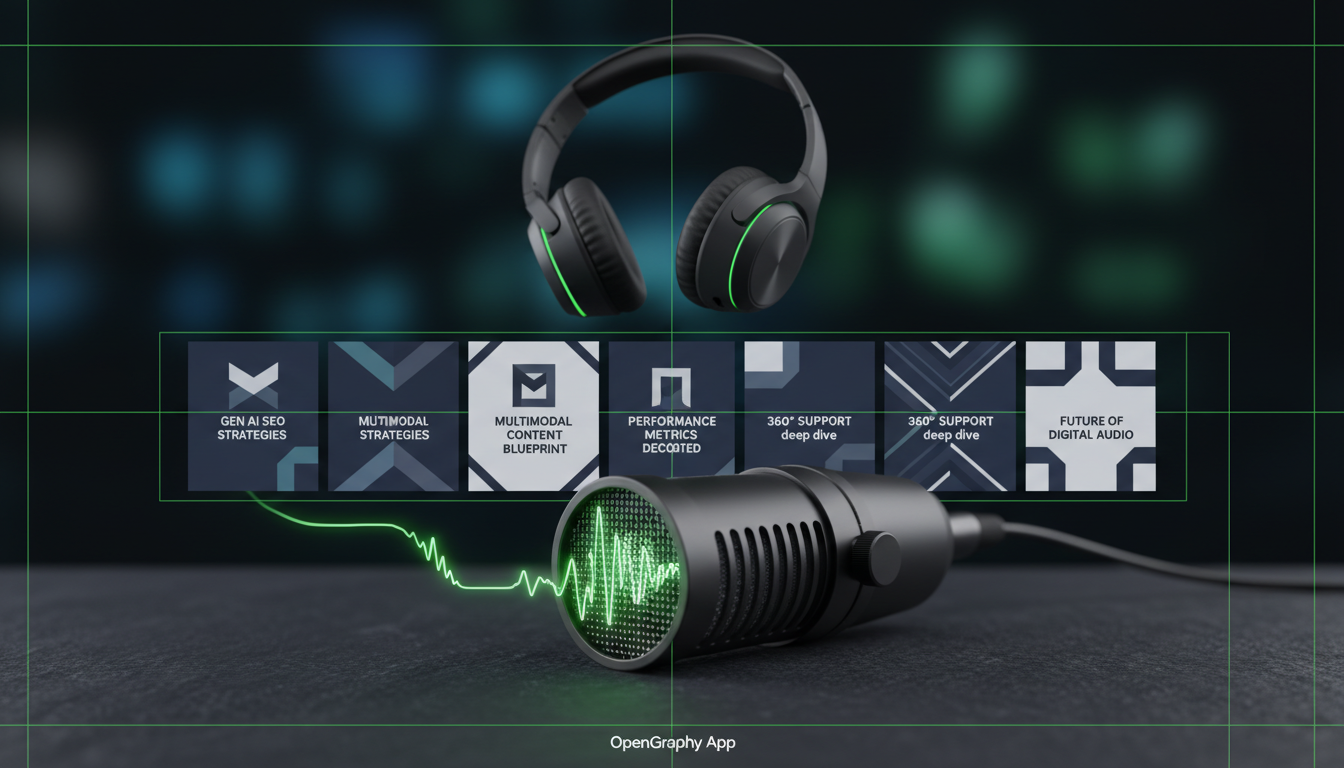
A 30-minute podcast episode is a content goldmine — done right, it becomes 30+ pieces of derived content across blog, social, video and email. The B2B podcast strategy that compounds isn't about audience size; it's about the production-and-repurposing operating model that turns each episode into a multi-channel asset.
The classic B2B podcast pitch is "build authority through long-form audio." That's true but incomplete. The teams that get real ROI from podcasts treat the audio as the source asset for a multi-format content engine: each episode becomes a pillar article, 10+ social posts, quote cards, video clips, an email digest, and AI-search-citable transcripts. The audience listening to the podcast itself is often the smallest beneficiary.
This guide walks through the full B2B podcast content strategy: how to plan episodes that produce high-derivative-value content, the repurposing operating model, the AI visibility benefits podcasts uniquely deliver, and the agent stack that runs the program with one producer instead of three. By the end you should be able to design and operate a podcast program that compounds across channels rather than competing with them.
Planning Your Podcast

The single highest-leverage decision in B2B podcasting is what to talk about, in what order, with whom. A great episode follows a narrative arc — not a random conversation. The OpenGraphy Podcast Script Generator produces structured episode outlines that respect the narrative requirements.
The narrative arc per episode
Five beats: Hook (a specific question or claim that frames the episode), Intro (context-setting and guest framing if applicable), Act 1 (the surface answer most people give), Act 2 (the deeper answer or counterintuitive insight), Outro (the actionable takeaway). The arc gives episodes shape; without it, episodes meander and derivative content suffers.
Episode topics that compound
Three patterns over-perform for B2B podcasts. Buyer-question episodes — answering the questions your sales team gets repeatedly. Industry deep dives — the why behind a market shift or a product category trend. Customer story episodes — a specific customer's transformation, with concrete data.
Cadence over heroism
Weekly episodes compound; monthly hero episodes don't. The compounding signal both for audience retention and for AI-search authority requires consistent shipping. If you can only sustain bi-weekly, ship bi-weekly — but commit to it.
Content Repurposing

Every podcast episode is a content goldmine. From a single 30-minute episode, the right operating model produces 30+ derivative pieces across formats. This is where the real ROI lives.
The repurposing matrix
From one 30-minute episode: a 1,500-word blog summary article, 10–15 LinkedIn posts (one per insight), 5–8 X threads, 3–5 Instagram quote cards, 2–4 short-form video clips for Reels/Shorts, an email digest summarizing the episode, an AI-search-citable transcript with schema markup. Done in parallel by the agent stack, not in series by a marketer.
The agent-driven repurposing workflow
The Research Agent ingests the transcript and pulls insight units. The AI Writing Agent drafts the blog summary. The Social Agent creates platform-native variants. The Video Generator creates short-form clips. The Publishing Agent distributes everything. See Multi-Channel Publishing Automation.
Production timeline
Most B2B teams ship one new episode per week + 30 derivative pieces, with under 5 hours of weekly producer time once the agent stack is configured. The traditional podcast-team headcount of three (producer + audio editor + social coordinator) collapses to one producer plus the agent stack.
AI Visibility for Podcasts

Podcasts have a specific AI-visibility benefit most B2B teams under-exploit: they reinforce topical authority across multiple formats simultaneously. AI models reading your blog and your podcast transcripts and your video clips treat the brand as a multi-format authority — which weights citations more confidently.
The multi-format authority signal
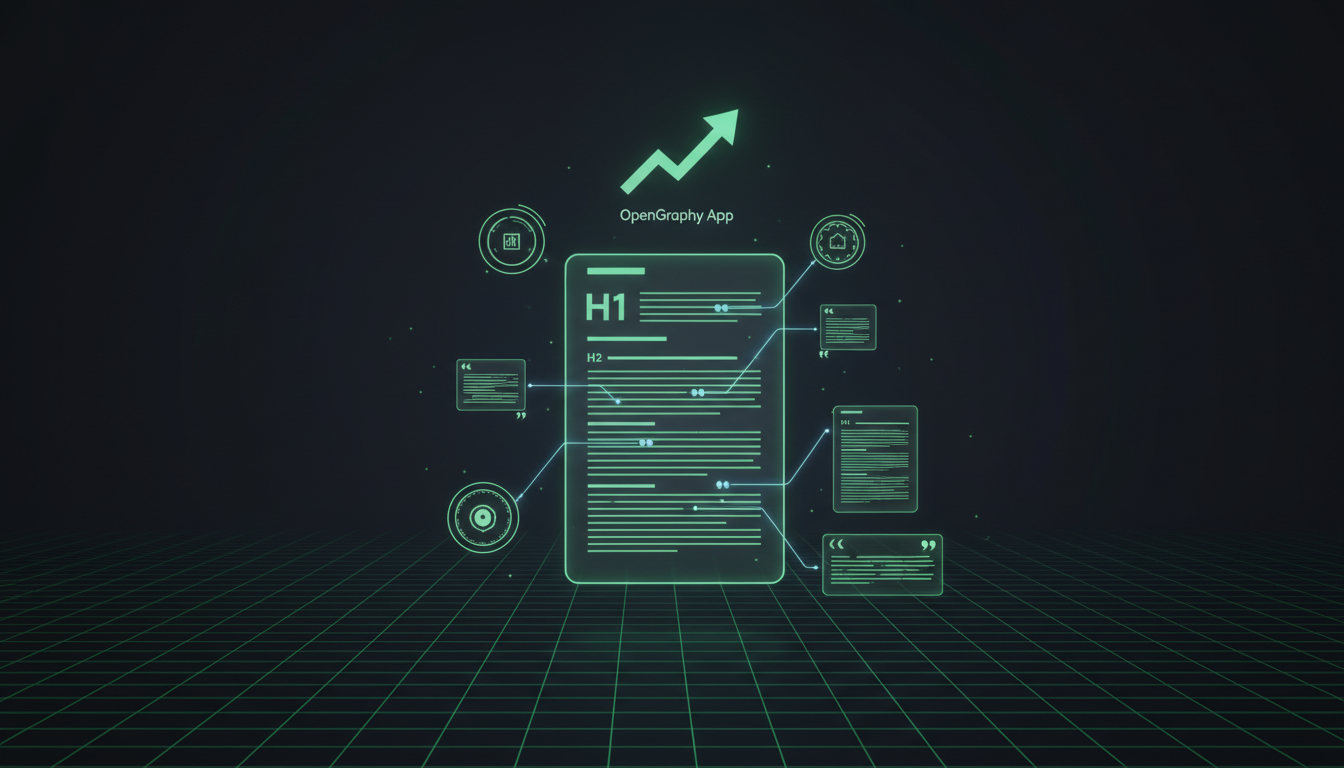
When ChatGPT or Claude builds its representation of your brand, it reads your articles, video transcripts, podcast transcripts and social posts together. A brand discussed across multiple authoritative formats reads as a stronger authority signal than the same content output through one format. The OpenGraphy diagram captures the convergence: articles + videos + podcasts all reinforcing the same topical authority node.
Transcript optimization
Publish episode transcripts on your owned property with full Article schema, FAQPage schema for the Q&A segments, and time-stamped chapter markers. AI models extract from podcast transcripts heavily — but only when the transcripts are present and structured. Audio-only podcasts leak the AI-visibility signal entirely.
Topical cluster benefit
Podcast episodes that map to your blog cocon-sémantique compound the cluster's authority. Episode on "AI Visibility Score" pairs with the pillar article; both reinforce the same topical node. The compounded signal beats either format alone.
Distribution: Where Your Podcast Should Live
Audio platforms
Apple Podcasts, Spotify, Google Podcasts, YouTube as a long-form audio destination. Distribute across all four; audience attention fragments by platform.
Owned property
Episode pages on your own site with full transcript, schema, internal links, and CTA. This is the AI-visibility-critical destination — without owned-property episode pages, the AI-search benefits don't compound.
Social derivative ecosystem
Each episode generates a wave of social content (LinkedIn, X, Instagram, TikTok, YouTube Shorts) over 7–14 days. Schedule the wave with the Scheduler Agent; distribute via the Publishing Agent.
FAQ: B2B Podcast Strategy
How big does my audience need to be for a B2B podcast to be worth it?
Less than you think. Even with under 500 listeners per episode, the derivative content (blog summary, 10 social posts, video clips) produces ROI by itself. The audio audience is often the smallest beneficiary.
How long should B2B podcast episodes be?
20–35 minutes for most B2B audiences. Shorter (10–15 minutes) for daily news-style podcasts. Longer (45–90 minutes) only for deep-interview formats with established audiences. Most B2B teams under-trim and produce 60-minute episodes that should be 30.
What's the right cadence?
Weekly compounds fastest; bi-weekly is sustainable for smaller teams; monthly is below the cadence threshold for compound effects. Pick the most aggressive cadence you can sustain for 12+ months.
How do I produce 30+ derivative pieces per episode without burning out?
The agent stack. The Research Agent + Writing Agent + Social Agent + Video Agent handle most of the repurposing. The producer's job is editorial direction and quality review, not manual repurposing.
Should I publish full transcripts?
Yes — on your owned property with full schema. Audio-only podcasts leak the AI-visibility signal that transcripts capture. Transcript pages also give AI models extractable content for the topics your episodes cover.
How do I measure podcast ROI?
Five metrics: derivative content output (pieces produced per episode), topical authority lift (stress-test position changes on episode topics), cross-channel engagement (social engagement on derivative content), AI citation frequency (transcript-driven citations in AI Overviews and ChatGPT), and direct attribution (CRM-tracked podcast-influenced pipeline).
Going Further
- Creating Social Media Content at Scale — the social derivative layer.
- Using Templates to 10x Content Productivity — episode and derivative templates.
- Multi-Channel Publishing Automation — the distribution layer.
- Knowledge Graph Optimization for Brands — multi-format authority compounding.
- Autonomous Content Creation with AI Agents — the operating model.
Ready to put this into action?
Explore our Content features and start optimizing today